Tuesday, October 02, 2007
All Things Being Equal
We continued our work on the "Asking Questions" strategy, this time using the OCR text. The students read the story "Mae Jemison: Space Scientist" aloud, and as we were reading the used post-it notes to annotate the text with their questions. We shared some of these as we went along, and then when we were towards the end of our Open Court time, the students took the post-it notes out of their books and put them on a piece of paper together with the quoted section from the text which had provoked the question. For example, on page 80 of the text, Mae just goes to medical school. The author provided no background for this decision and one student wrote, "Just why does she want to go to Medical School?" What a great example of "Questioning the Author"!
We took our Science test after lunch. It may take a few days to get these graded and posted on the website, but we will let you know how they did. Incidentally, if you did not have a chance to read Sandy Bank's column in today Los Angeles Times about receiving email notifications of grades, do read it. I think it's both amusing and relevant.
The last 45 minutes was a little noisy, but it was good noise. We introduced the concept of equivalent fractions today and used fraction bars for the first time. You can see these in the pictures above. New math manipulatives always put children in a more playful than studious mood, but they quickly and quite visually grasped the idea that certain fractions like 6/12, even though they appear large, are really the same as a smaller-looking fraction like 1/2.
Home Studies: (1) Open Court packet -- this should be a fairly fast one. (2) Begin work on Math packet. This will be due no later than October 15, but it would be great if it were finished and corrected well before then.
Since students did reading in the morning, no reading is required as part of the homework.
Monday, October 01, 2007
Sun and shade
Questioning
We started off today with silent reading. This will be a pattern for most of the students now that the Thinking Maps project is basically finished. I worked with one student to complete the oral part of the CELDT test while the other students not only did their silent reading but completed the reading journal. You'll notice that does not appear as part of the homework tonight, though, of course, they can read some more if they have the time.
We worked on "Asking Questions" as a reading strategy. This is an important, but somewhat hard, skill for students. Fourth grade students are generally pretty passive when they read, and it never occurs to most of them to challenge a character in a story, much less the author. Yet that is just what good readers do all the time. Good readers ask, "Why the heck is the author doing this? Why did she pick this setting? Why give the character that name?" That's just what we tried to help the students do today. They read a bit of the YA classic The Great Gilly Hopkins and as they read the first chapter -- which I had photocopied for them -- they wrote questions which we shared as we went along. The questions, to be sure, could have been tougher. But just asking any questions, just challenging the text in any form, was a new experience for most of the students. We'll practice it some more on the Open Court text tomorrow.
After recess the students had a chance to look at the results of Friday's science experiment. They were surprised to discover how the elodea which had been left in the sun suddenly had so much air in the test tubes compared with the shade control. They were not completely sure why. Most felt that evaporation was the key, but others identified photosynthesis as the likely cause. Which of these two it is was less the point than the idea of making an experiment, and controlling it for only one variable.
The rest of the day was pretty routine. I read a chapter of The Witches; we identified rhythmic patterns in groups of words; we exercised and continued the kickball tournament; and finally we talked about fractions of a whole and fractions of a set.
Home Studies: (1) Complete the Science review, pages A34-35. There will be a test on Science tomorrow. (2) Do the "Natural Resources" study sheet. There will be a social studies test on Wednesday. (3) Do the "Multiplying by One Digit" worksheet. We did not discuss this in class, but it is a third grade skill. If your child has trouble with it, let me know.
Friday, September 28, 2007
Elodea
So it was, at best, an OK day. But we did have one high point, as you can see above, and that was our science experiment. We did this jointly with room 18 as we had most of the stuff needed and even more to spare. They supplied us with some boba drink tops, a neat substitution for the nearly-impossible-to-find funnels. Here's how the experiment went. Students had to put a piece of elodea (that's the aquarium plant I'm holding in the pictures above) under the boba top with a test tube sticking out of it. This odd arrangement was mostly covered by water in a plastic shoe box. Some of these will spend the weekend out in the sunshine, while others will be in the closet in the dark. What will happen? We'll see!
Home Studies: Do the final study sheet on the first chapter of the Science questions. Do the subtraction worksheet.
Thursday, September 27, 2007
CELDT out!
But we do have somethings to boast about. The students have finally completed the eight "About Me" compositions we did to help them learn about Thinking Maps, and several have already bound them into our first books. They were quite proud of themselves, and when the other students saw the finished product they were suddenly incredibly motivated to finish their own!
We took a math test that we will grade tomorrow. We also prepared for doing a science experiment tomorrow. We continued listening to The Witches. We read an amusing play version of The Emperor's New Clothes and we read an account of the Dust Bowl of the 1930s. Students have a little homework related to this tonight.
Home Studies: (1) Continue independent reading and writing in logs. (2) Do "Sentence Chef," Storyworks, page 15. (3) Do the two Open Court worksheet pages. These are numbered 29-31 on the very bottom in small print. (4) Finally, do the Subtraction Practice worksheet.
Wednesday, September 26, 2007
Inferring
This happens a lot during reading. Students who can otherwise make intelligent comments and observations will often just be lost when a teacher asks a questions which is not "on the page." They start to look a little confused and agitated even when the question begins "Why do you think..." I suppose this is because so often in school we are focused on reading carefully and correctly that we forget that the purpose of reading is to promote thinking. So students get into the habit of plodding from word to work, reading the words fairly smoothly, but often not bothering to think what they mean.
We've been working on this problem. We've tackled a couple big thinking skills in reading already - predicting and making connections. We continued on this today by looking at a specific reading skill, the ability to make inferences. I began my lesson by explaining to the students that they were already expert at making inferences, and they proved this to me when I gave them a few facts about an imaginary situation. For example, I told them that they could not see the TV screen but that they heard someone say "doughnuts" and another person say, "Excellent!" They knew immediately that The Simpsons had to be the show on TV. I explained that they had used what they already knew (in this case, Homer's and Mr. Burns' favorite expressions) in order to make this inference.
We then tried to practice the skill on our Open Court story. We had visitors from the Local District looking at our implementation of the reading program, so we used the workbook as our tool today to do this. I will not say that the students were thrilled by the work we did, but they did seem to clearly master the skill. We will continue to work on the skill, though in the future we will be more likely to use post-it notes, reading logs, and graphic organizers to help us here.
The rest of the day was pretty routine. We finished up reading the first chapter of the science book, and most of them finished the chapter 2 math assignments and checked them. A number of students went off to orchestra orientation while the rest of the students went to PE.
Home Studies: (1) Reading, 15 to 30 minutes plus entry in reading log. (2) Open Court Reading worksheets -- Sarah study questions, the crossword puzzles, and the Crazy sentences. (3) Finish the math packet, if not already done.
Tuesday, September 25, 2007
Not much Today
Home Studies: (1) Independent Reading, including the reading journal. (2) Continue work on the chapter 2 math assignment sheet. This is due Thursday, but it would be great if it could be done and checked earlier.
Monday, September 24, 2007
No Monday Moaning Here
We changed seats today just before going to recess. It takes me a couple of weeks to get a good feeling for each child's personality and to know what seat would provide the best opportunity for focus and constructive collaboration. After recess I gave students an opportunity to work on the latest History packet pages. All of them will be doing some -- or a lot -- of work tonight to finish these, but I wanted them to understand what I am looking for in these study guide assignments and how they will be helpful to them on the test. (Of course, the most basic reason for creating the assignments is to sharpen reading and thinking skills, but talking about that is not motivating for the fourth grade mind!)
After lunch we continued work on our Writer's Workshop compositions. A number of these are quite creative, and I look forward to publishing some of them shortly. We had PE where we continued our kickball tournament as well as working on cardiovascular fitness. We concluded with some Math workshop time, and I gave a mini-lesson on rounding with them.
Home Studies: (1) Independent reading and writing summaries in log. (2) Conclude work on the History packets pages for lessons 3 and 4 of chapter 1. (3) Continue work on math pages. These should be finished by Thursday at the latest, but earlier is even better.
Thursday, September 20, 2007
Cause and Effect
We began today with a look at our seventh Thinking Map, the Multi-Flow map. This diagram looks a bit like one of those flow charts they use to teach computer programing in Basic. Its purpose is to help students to understand the ideas of cause and effect. Now this is a surprisingly hard idea for the fourth grade mind. Children are accustomed to the idea of sequence -- indeed, in compositions just about every sentence can begin with the word "then" -- but understanding that one thing happens because of, or in response to another action, is not something that they easily grasp. And yet no concept is more important for Science or History or even literature.
Our Multi-Flow Map was about "My Dream." The students were asked to think of what they would ideally like to achieve in their lives. They had some interesting choices. Many wanted to be actresses or sports superstars, of course, but others chose such realistic goals as zookeeper or fashion designers. They were then asked to think of what they would have to do to achieve that goal. Many were pretty accurate about understanding the prerequisites for the field they chose. They did tend to underestimate the price of mansions in Beverly Hills, however.
We reviewed the Toto story, looking this time to "make connections" between the text and their own lives. I'll talk more about that tomorrow. We also corrected the math test. This was a mixed result -- many excellent scores, but also a number of disappointing ones. We'll do some review here, particularly with the students who need it, and take the alternative form of the test in a week or so. We'll give the better of the two scores to the students.
We worked a little more on music today. This was the only rough point of the day. Doing some of the basic preparation activities for singing, exercises things involving breathing and vocal control seemed to bring out a particularly silly side in some of the boys. It was much better when we moved on to working on finding the rhythm in jump rope rhymes. We'll be developing a beginning sense of rhythmic notation from this as well as learning to change these chants into body percussion pieces.
The end of the day was a kind of workshop where students could work on math or the language arts homework. It was peaceful and everybody was working quite intently.
Home Studies: (1) Independent Reading. I will be collecting the first group of journals tomorrow. (2) "Toto" story packet. There are quite a few pages here, and the most important of these are the three pages of questions in the middle of the packet. (3) We started the second math assignment sheet. This will be due September 27.
Wednesday, September 19, 2007
Best Yet
We keep working diligently through our Thinking Maps, and today we worked on the Brace Map. This is not an easy map for the children to either understand or make, at least at first. The Brace Map works on the skill of understanding the relationship of the whole and its parts. It only applies, however, to things which are tangible, which can actually be put together or taken apart. We talked about this at some length until I felt they had the idea. I then challenged them to create their own. As always, the topic was something about them. Now the assigned topic here in the training manual is "My Best Outfit." I find, however, that most of the boys, and even a few of the girls, hate writing about this. As a bit of a slob myself, it's not an easy topic for me, either. So I gave them the option of writing about "My Favorite Meal" instead, and most of them seemed to enjoy that one.
I then had to change my plans when I runner reminded me that I was supposed to send selected students to the auditorium to discuss possibly being in orchestra next year. Almost half of the class qualified for this privilege, so I gave the remaining students the option of correcting math or working on Writer's Workshop. It was pleasant and quiet and productive.
After recess we did a little review for the math test, touching on all the important points. We then read a chapter from the social studies book on bodies of water in California. Dull, but important stuff for understanding the state. We looked at our mealworms again after lunch. Many had died, but a couple had changed into beetles or were in the process of doing so. We also read a short, and frankly pretty trite, story from the Scholastic magazine. We continued with our kickball tournament in PE. After PE, we came in and took the math test. We'll correct it soon and get the results on the gradebook.
Home Studies: (1) Do independent reading. Remember, students should read for at least 15 to 30 minutes daily and write about a half page summary in their journals. (2) Do the short vowel and Characterization worksheets on the Open Court Reading story. (3) Do the questions on the Adaptation chapter we read yesterday in the Science book. I added some page numbers to the questions to make this even easier.
Tuesday, September 18, 2007
Happy Days
Just a wonderful day. We began by doing final drafts of our "My Favorite Things" composition we did yesterday. We've completed five of the eight Thinking Maps, and I think the students are getting the idea of monitoring their own thinking and using these simple graphic devices to focus their thinking.
Then we did something really neat. Yesterday we had noted descriptive language in the "Toto" story by writing the words or phrases on little yellow post-it notes. Today we shared some of the words and we used these to create some wonderful African landscapes. It was hard for a few of the students who are accustomed to relying on the illustrator instead of the author to help them form pictures, but the results were excellent. You can see some above.
After lunch we did another really neat Science activity. We used chopsticks, clothes pins, and spoons to imitate different types of beaks. The students used each one to pick up a variety of different types of foods such as gummy worms, rice, bird seed, etc. They had to figure out which type of "beak" was best adapted for each type of food. They had a great time, particularly eating the peanuts and sunflower seeds afterwards. That led us naturally into a reading of the Science text, and boy were they attentive. Hands-on science is hard work, but it's really worth it.
The rest of the day was devoted to finishing the math packet. I helped students who needed it, and some of the students who were already done also volunteered as tutors. We'll be having a test on this tomorrow after doing some review.
Home Studies: (1) Do independent reading. Remember, students should read for at least 15 to 30 minutes daily and write about a half page summary in their journals. (2) If not already done, finish the math packet. There will be time to do some correcting tomorrow, but no more work on it in class.
Monday, September 17, 2007
Making Mental Movies
Other than the computer problems, a splendid, if fairly routine, day. I'd like to just focus on one key thing we worked on today. And that is the skill of making mental movies. Now, this is something that kids are do pretty well. In fact, we adults complain all the time that they are "daydreaming" when they should be doing something we deem more productive. Yet somehow they have trouble taking this natural aptitude and applying it to reading. I suppose that our obsession with making sure that they read correctly and quickly has a lot to do with it. But the results of not "daydreaming" while you read are quite bad, almost tragic.
Reading really isn't about how correctly or rapidly you recognize the words. Instead, it's about getting meaning from print. And to do that, readers need to become absorb the ideas, not the words. For fiction, and for a lot of nonfiction too, this means that they need to be able to "see" the setting, the characters, and the events in the story. They need to combine the description that the author provides with stuff from their own life and turn it into a mental movie. Good readers don't read books, the "watch" them. That's why a good reader almost always finds the Hollywood version of a favorite book so disappointing: our brains are capable of the most fabulous special effects, far better than anything Industrial Light and Magic can do, and the actors we cast in out heads are so much more talented than the ones who hold SAG cards.
All of this takes a little willingness to pause from reading and to let the pictures form in our heads. It's a skill everybody can learn, though it may seem awkward at first. It's particularly hard to practice this at school where you are sure that everybody else is looking at you, and where the teacher always seems to be perpetually in a "hurry up" mood. We are working on this skill however in our busy classroom. Today as we read the wonderful "Toto" story in the Open Court text -- I think it's the best selection in the book -- the students looked for descriptive words and put them on post-it notes. Tomorrow they will look for some more, and after we share these we will work on creating first a mental picture and then making an actual color picture just from the words. It should be interesting. Keep tuned to see some of the results!
Home Studies: (1) Independent Reading: Students should be reading about 30 minutes each evening and writing a short -- roughly half page -- entry in their reading journals. I will start collecting these Friday. (2) Finish the chapter in the math book, if not already done, by Wednesday at the latest. (3) Finish the History packet. We started this one in class. (4) Do the two fairly short Open Court pages.
Thursday, September 13, 2007
Mealworms
Wednesday, September 12, 2007
There's Got to be a Morning After
After our wonderful meeting last night I confess I decided to sleep in this morning. So I arrived at school in a great mood, with little actually prepared to teach them for the day. But, ah, this is when 20 years of teaching experience comes in handy. I pulled some tried and true lessons out of the hat, and we had a great day.
We continued our study of Thinking Maps with the Flow Map. This is one of the most useful of all the Thinking Maps because it works on sequencing, an all-purpose elementary school thought process. We did two activities with the map. First, we did one of the best parts of the autobiography project, a composition about "My Perfect Day." The idea for this writing assignment is sort of a combination of Queen for a Day and 24. The students have all the money they want or need, but only 1 day, and they have to put together a morning, afternoon, and evening of perfect activities. We shared some of these, and a couple were really quite touching. After that, we revisited the "Mrs. Frisby" story from Open Court. We talked about the four basic phases of plot development - exposition, rising action, climax, and falling action - and traced these through this selection. Students than made a Flow Map of the story, making their own illustrations of each important phases.
After recess, we returned to the room where we read the next section of the social studies book about the four regions of California -- the coast, the Central Valley, the mountains, and the deserts. This is not the most stimulating stuff for the kids - other than learning that we have an active volcano somewhere in the state - but it is important for them to know the geographical context in which the history takes place. We had done some maps of these regions Tuesday, so at least the idea of the regions was a little familiar to them.
Lunch was uninspiring - who decided that ranch dressing is the perfect accompaniment for peanut butter and jelly? - but we had a lot of fun when we came back to the room. We began our study of singing today by teaching the children how to stand and how to breath. This is very important for good vocal production, but they find it pretty strange, if not downright weird. We also worked on finding the beat in some short bits of piano music I have on a CD. Students used their bodies as pendulums to show the duple-meter beats. We continued this discussion of beat, rhythm, and meter by again using the "Marco Polo" jump rope chant, this time by adding the technique of body percussion. Fourth grade students love to slap themselves, stomp their feet, and click their fingers. I also brought in a simplified system of stick figures to indicate divide and undivided beats. This will prepare them to read standard musical notation later on.
PE was much the same as Monday - warmups, laps, and activity rotations. After we returned to the classroom we took some time to work on math, doing more with our base 5, base 12 counting and also to work on a "Problem of the Day," a slightly open-ended math problem which also requires the students to explain how they came to the correct answer. These kinds of narrative explanations help me to decide who is truly advanced in their mathematics instincts.
Home Studies: (1) If your child did not complete either of the Thinking Map assignments those need to be turned in first thing on Friday. (2) Do new packet of follow-up materials for the "Frisby" story. (3) Continue work in the read math folders. We should have the self-correcting materials ready soon.
Monday, September 10, 2007
Hands On
What a great day! It start out quietly, but after recess it built to a wonderful bang!
We began by doing final drafts of a couple compositions which students had done with their thinking maps last year. They finished the "All About Me" and "My Character" sections of the Thinking Maps autobiography project. By the end of the month all eight sections of this project should be written and revised and the students will make it into their first book of the year. As we usually do on Mondays, we shared stories about the fun things we did on our weekend. The students generally had more fun than I did! They're lucky to have such great parents and friends.
We then turned our attention to Open Court. Most of the students had brought pictures of somewhat risky activities, and then shared the risks and benefits of the activity with the class. I suppose when they have to do their first cost-benefit analysis in Economics they'll say, "Hmmm. Didn't we do that already in Fourth Grade?" We then went on to discuss and practice Predicting as a reading strategy. Research shows that good readers approach the text in different ways from poor readers, even when both can sound out the words equally well. We will be explicitly discussing and practicing these strategies. Today we discussed the role of making and checking predictions when the children read. We practice this using the first part of a wonderful picture book by Chris van Allsburg called Produtiti! I typed up the first five or six pages and left a column for the students to write their predictions and other comments as we went through the text slowly. They were a little confused at first about what we were doing, but they quickly got the hang of it. They made some pretty good predictions with a story that takes some odd twists.
Then the fun really began! We did our first science experiment today. "Hands on" science, as they like to call it these days, is fun, enriching, and absolutely exhausting at times. It's particularly like that when we're working with bugs! Today's experiment dealt with mealworms. We placed a small cup of bran meal, a cup filled with 20 corn flakes, and a small cup of water. We placed about 6 - 8 giant mealworms in each shoe box. After lunch, we came back to see what the mealworms are doing, and we will check on them again after lunch tomorrow. All of this is to see how organisms need, and meet their need for, food, water, air, and shelter.
We went off to PE where students did warmups, two laps, and rotations among three various sports/fitness stations. After that, we finished off by checking over the math pretest we took on Tuesday. They did surprisingly quite well on it!
Home Studies: Work on the two pages of Science questions and skills in the green Science folder.
I hope as many of you as possible will be able to come to our Back to School Activity tomorrow at 5:00 pm. You can bring small children with you in class, and a fully-credentialed LAUSD teacher will be available to supervise older children on the yard.
Friday, September 07, 2007
Great Day
But the kids were super and we had a great day. We began the day correcting yesterday's math work. We went on to discuss the Circle Map, the graphic design used in the Thinking Map program to model describing. I find the Circle Map unnecessarily restrictive, since only adjectives can be used in all but one of the circles. But the students did quite well dealing with this rule, and they went on to write some good paragraphs about their personal characteristics. Monday and Tuesday we will do final drafts of the two compositions done so far, and then on Wednesday continue with the Double Bubble Map (which has nothing to do with chewing gum).
After that, we looked at the first page of the Open Court packet and discussed what "risks" and "consequences" were. It was a good discussion. The students then went on to create entries for our Concept/Question board. If you are not familiar with this feature of the Open Court program, I'll show a picture of it next week on the blog when it is more complete. It is a tool for creating communal knowledge about our theme as we go from selection to selection in the book.
After recess, we did an art project exploring geometric shapes and the color wheel. Students made a number of large, overlapping geometric shapes, and assigned a color to each. In areas where the colors overlapped, new colors were created. They continued this project after lunch. As we have previously done during music time, the students took time to reflect on the project in the Arts journals after they finished. When everybody was done we did a "gallery walk." This is a technique for positive self and peer evaluation. The students walked silently around the room and looked at everybody's work. I then asked who they thought done done a good job and why. It's a very supportive kind of critique which really helps the children grow as artists.
We went out to PE. Thankfully, the heat has subsided a little, and our exercise and laps were done fairly easily. After that, the children were able to choose sports/play areas for the remainder of the period. We came back from PE and watched a fun Bill Nye video about insects. Next week we will be doing an experiment with mealworms -- that's what the shoe boxes are for -- and we will be studying the topic of adaption in the textbook. The film helped give us some ideas to think about in preparation for this.
Home Studies: Light tonight -- the teacher has a lot of grading to do and needs a break already! Just bring in a picture from a magazine of something risky. This could be a good risk, like fire fighters entering a burning building, or a bad risk like doing drugs. Try to "think outside the box" here and come up with something original.
Thursday, September 06, 2007
Getting in the Swing of Things
But we are getting our routines established, and the students are adjusting well. Today we began with our first discussion of Thinking Maps. We talked about the Circle Map, and the students did a Circle Map about themselves and the people who have influenced them. They then turned this into the rough drafts of a short, two-paragraph composition. They will do the final draft tomorrow. We will follow the same pattern for all 8 of the Thinking Maps, and when they are done the students will assemble these compositions into their first book.
We finished the "Let Me Introduce" assignment they started yesterday. Students had previously interviewed each other and done a rough draft of a composition. They had also started to do a portrait of their table partner. Today we finished this. We did final drafts, mostly in cursive, and used oil pastels to color these. You can see three of the very best ones above. We have some talented artists here.
The students did their math pretest today, and they corrected their language arts pretests which they took yesterday. Fourth grade students do not like pretests, and I cannot really blame them. It seems a little unsettling to be tested on something you haven't studied yet. But they are useful tools for teachers to help us pinpoint strengths and weaknesses. So far it looks like our students need work in grammar, but do well in spelling and reading comprehension. We haven't checked the math yet, but I suspect fractions and beginning algebra will be the weakest areas there. There's nothing wrong with that: those are true fourth grade math objectives, not weaknesses from inadequately mastered second or third grade work.
They were pretty restless after lunch, so I gave them some routine addition and subtraction practice from the math book to help focus them. A few of them will need to finish this as part of the homework tonight, but most did it fairly quickly. We did some more work in music, focusing on the areas of beat and rhythm. Students practiced finding the beat in a jump rope chant and a short piece of music. They also practiced finding the stressed beat using the first syllable of their name as a kind of downbeat.
Home Studies: Complete page H34 if needed in the math book. Do the first language arts packet -- see black folder. This is preparation for reading the first story in the Open Court book.
Wednesday, September 05, 2007
Welcome
This blog is one of the most important ways I communicate with parents. On the blog I will be giving a description each day of what we have done in class, and I will often reflect on the days events, sharing joys and sometimes frustrations. I will often show some pictures of what the students are doing or examples of some of their art work. I will announce important upcoming events on the blog, and I will end each day's entry by indicating what the students may be doing at home to further their learning. I suppose you could call that "homework" but I am really trying to get away from the traditional model of taking home a bunch of papers and bringing them back the next day. More on that as we go along.
The other critical way I will be communicating with parents in through an electronic report card. I encourage you to send me an email as soon as possible so I can give you access to the online gradebook. Again, I will be explaining more about this as we go along. My email addresses are either jbasse1@lausd.net or johndavidbassett@gmail.com.
I am having a special "Back to School" evening for our class on Tuesday, September 11. It will be at 5:00 pm. I would like to take this time to provide you with a more in-depth introduction to the fourth grade curriculum and to discuss policies and procedures with you. I hope all parents can attend.
Home Studies: (1) Sign copy of discipline policy and return it tomorrow. (2) Bring in a photograph of yourself - I mean the student here, not the parent - taken someplace in California, preferably someplace memorable. An example might be in Yosemite National Park or at Sea World in San Diego. The photographs are for a bulletin board and will be returned. (3) Try to find a shoe box and bring it into class by next Monday. We only need one for every four students, but I would rather have too many rather than too few. This is for a science experiment.
Tuesday, September 04, 2007
Friday, June 09, 2006
Final Units
We started out today by going over our homework and having the spelling test. Students are having problems with multi-digit multiplication; spelling was generally good. Both scores should be on the Gradebook now. Big thanks to Mr. Benitez for helping here since I had been asked to go off to a Friends of Third board meeting to discuss our arts education plan. We then started a short unit we’ll be doing on various native groups — beyond those in our area — and their art. This will help prepare the students for our trip to the Southwest Museum a week from Tuesday. We read a couple chapters in the old social studies text. We did some comprehension questions on one chapter and did a Kwakiutl mask project on the other. We also played some good softball today.
Things are winding up. Remember we have two field trips in the last week — the one to the Southwest Museum and the other our walking trip for the picnic in Pan-Pacific park. I already have signed permission forms for these on file.
Homework: Do the division review study sheet. Be sure to include the check step.
Wednesday, June 07, 2006
Quiet Day
We played softball again after recess, and they're finally starting to do some decent teamwork in the outfield. That's as much a social skill as it is an athletic one! I read them some more of The Wind in the Willows after PE while we waited for our lunchtime.
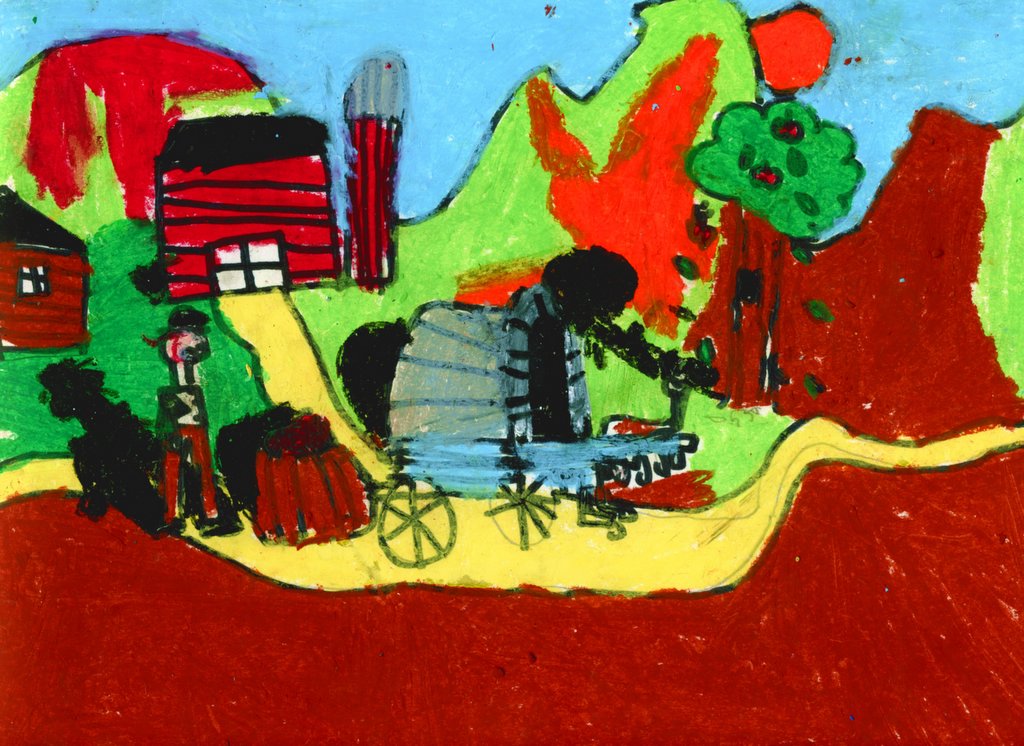
After lunch, we reviewed the various solid geometric figures and how they can be combined in drawings of houses and other buildings. Students then went on to do some pictures of farmhouses connecting this math topic to our OCR unit. We'll have some of them on the blog tomorrow (if I remember to bring fresh camera batteries from home....)
Homework: (1) Study spelling. (2) Do the math worksheet -- side 1 deals with comparing numbers and the other with addition and subtraction. We'll really stress this in the last few days because this is a skill which should be second nature to them by now.
Tuesday, June 06, 2006
Back in the Groove
A nice day! We worked on our “To the Moon” unit in Into English!, particularly reading the retelling the Peruvian folktale. We started work on some flow maps here — we’ll finish these tomorrow. We did the blending and vocabulary for our last story, “The Country Mouse and the City Mouse.” We read through and briefly discussed this. We’ll talk about it more tomorrow in greater detail.
After recess, we continued our softball tournament. Students and starting to get pretty good. We also finished correcting the Open Court unit 5 test, our last for the year! Hurray!
After lunch we did the Open Court fluency assessment, again our last of the year. We also did some work with the Hands-on Equation program. Some students really understood what we were doing, while others were clueless. That’s OK: it’s really enrichment at this point.
Homework tonight focuses on getting a jump start on fourth grade map. Here we take place value from the 10,000’s place to the 1,000,000’s place.
Homework: (1) Study spelling. (2) Do the Expanded Form worksheet. Be sure to write the answer in word form on the back, too. (3) Do the Addition and Subtractions worksheet.
Wednesday, May 24, 2006
Wonderful Wednesday
They went off to the library and checked homework after recess; I had to attend a private school due process IEP. After lunch we played softball, practiced cursive, and had a brief time to get a head start on our homework.
Homework: (1) Study spelling. (2) Do the rest of the chapter review in Science, page E27. On 16-19 just write the correct letter answer; on 20 and 22 write two or three sentences to completely answer; on 21 and 23 carefully draw the food webs as indicated. (3) Do the Roman Numerals worksheet and the Area and Perimeter Review on the back.
Tuesday, May 23, 2006
Not an Early Tuesday, but a Good One
We had Independent Reading and Writer’s Workshop today. We continued work with the “Too the Moon” ESL unit that will be mandatory next year. It’s kind of fun really, and though primarily designed for English learners it has a bit to offer other students, too. We worked on creating a chant or rap out of a little poem about “What do you see in the Moon?” today. We also did the blending for the next Open Court Story.
We continued reading The Wind in the Willows. We checked our homework with Mr. Benitez’s help. We looked at form in music, particularly binary (AB) form. After lunch we went to play softball, and then just got a head start on homework during math class. Lots of parents had forgotten about the end of early dismissal Tuesdays, so we were a somewhat smaller group by the end of the day.
Homework: (1) Study spelling. (2) Do the Connecting Concepts diagram in Science, page E26. This is problems 10-15. And problem 10 really is there. (3) Do the Rounding to the Nearest 10 worksheet. Follow directions here carefully! (4) Do the Regrouping in Addition and Subtraction worksheet. This skill is still a lot shakier than it should be at this time of year!
Monday, May 22, 2006
The Unexpected
But before I discuss what we did today, a big "Thank You!" to all the families who helped make our class basket the hit of the Country Fair. It was amazing how full of tickets our box was. Special thanks to Cameron's mom for organizing this and making the purchases.
We started today by discussing the Fair and sharing other fun things we had done during the weekend. We then started a little bit on a literature study unit about the Moon by doing a Circle Map and a quickwrite of what we know about the moon. We then put together some writing folders, as we will be doing some concentrated writing during these last five weeks. We're going to keep the focus where it belongs! Well, we will at least until the last couple days....
We had indoor recess today, though some of the students had to make up unfinished work from Friday. We resumed reading The Wind in the Willows after skipping this during testing. We went to lunch a little earlier than usual, and then students watched parts of The Lion, the Witch, and the Wardrobe with students from room 17 after lunch. By that time it had cleared up enough for us to go out to PE. We returned after getting our exercise to doing a little math and then packing up for home.
A reminder here. Tomorrow is NOT a shortened day. There will be no more 1:30 dismissals this year on Tuesday.
Homework: (1) Science vocabulary, E21 numbers 1-9 only. (2) Multiplication practice worksheet. (3) Algebra worksheet -- use a "guess and check" strategy here to get the answers. Also, the problems with negative numbers are strictly extra credit.
Spelling words will follow tomorrow.
Friday, May 19, 2006
TGIF
Today we corrected our homework first thing, and then took our spelling test. Results for the test are on the Gradebook. We reread the “Just Plain Fancy” story, and discussed why the Amish think certain things are “fancy” and others are “plain.” The students had some good insights here.
After recess we read about food webs and made some models of these. You can see a couple of these above. We had a good discussion here about predators and prey.
We had rotations during PE today, and we finished up by reviewing the procedures for multiplying three digit by two digit numbers.
Homework: (1) Finish the “Fancy” questions. (2) Finish the science questions on E 21. (3) Do the multiplication worksheet.
Thursday, May 18, 2006
Normalcy (as President Harding said)
We read a story by Patricia Polacco called “Just Plain Fancy.” This is fictional account of two Amish girls who accidentally raised a peacock instead of a chicken and feared being shunned on account of the bird being too “fancy.” It’s a cute story, and the students find the whole idea of a community shunning a member fascinating. They always want to know the exact list of offenses which might bring this punishment. Maybe they’re a little worried about pushing the limits too far at home….
We discussed food chains in Science, and the children made food chains like you see above. A few children need to finish these. Many more need to finish the chapter questions on page E12.
After lunch, we had a delightful visit from some children in room 16 who shared their student-authored books with us. Every year the children in this fourth grade room have books professionally published, and I think it is a fantastic experience for them. A few of our children will be fortunate enough to do this next year.
We discussed two digit multiplication. This is the key homework assignment tonight. This is a hard skill at first, but students get good at it quickly.
Homework: (1) Study spelling. (2) Do the wordsearch — which uses some of the words from the spelling list. (3) Do the Two Digit Multiplication worksheet.
In addition, some students need to finish the food chains and others need to finish the Science questions.
Wednesday, May 17, 2006
Amish and iPods
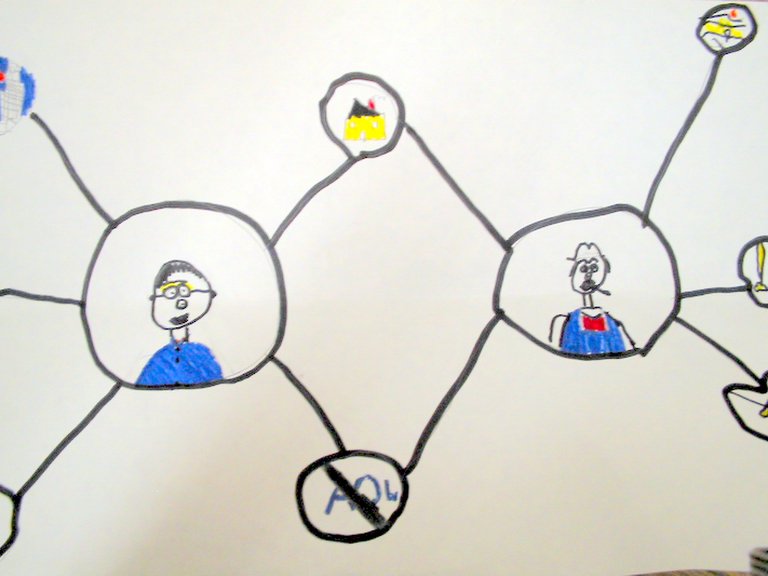
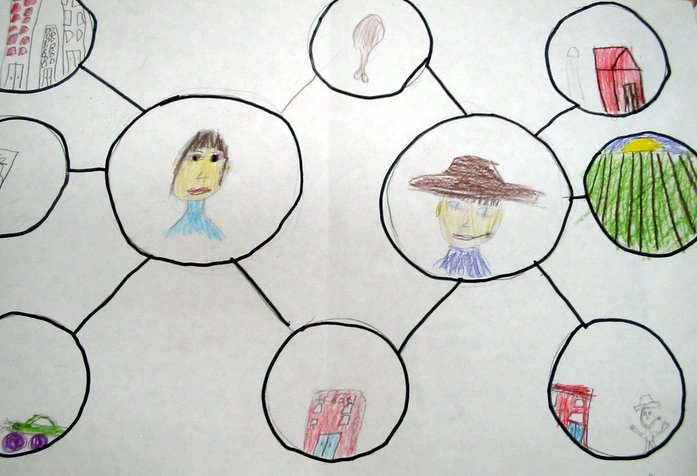
Today we continued to look at the “Amish” story. Students did a “double bubble” thinking map to compare and contrast their lives with the lives of an Amish child. You can see one of these maps above. We added a little bit of art to this by requiring the children to draw instead of using words on the maps. The children then took the ideas from these maps and wrote first and final drafts of a compare and contrast paragraph. A few children will be finishing these up as homework tonight.
We had library as usual and we also did some softball after lunch. The children are getting good at softball. Special thanks to Friends of Third for getting us a couple batting tees and catcher masks.
Speaking of thanks, we would also like to thank the many people who donated to our class basket. We’ve definitely got the most talked about item in the country fair. Everybody wants to get our iPod Nano and the iTunes gift cards.
Homework: (1) Study spelling. (2) Do the “Amish” study sheet. (3) Do the Multiplying with Money worksheet. In addition, a few students need to finish the thinking map and the paragraph.
Thursday, May 11, 2006
Day Four
Homework: (1) Study spelling. (2) Complete the three math worksheets on equivalent fractions, angles, and subtraction.
Wednesday, May 10, 2006
Thursday, May 04, 2006
Ox Cart Man
The homework below was assigned to complete after the art was done. As a result, some children have nothing to do at home tonight, while a few have a lot.
Homework: (1) Study spelling. Test is tomorrow! (2) Do the "Coded Words" worksheet. (3) Do the Equivalent Fractions review sheet. (4) Do the Section Review, Math, pp 356-357.
Wednesday, May 03, 2006
Practice Tests
It was another quiet yet pleasant day. We took the CST practice test in the morning, and most of the students seemed to do reasonably well. Testing starts on Monday and unfortunately third graders have 8 solid days of testing. I know you will make every effort to make sure your child is here each day on time. Making up missed tests is not only a logistical headache for teachers, but students never do well on make-ups.
Students went to library after recess, and I had to go to an IEP meeting. Because of this, the students had an additional lunch recess. They liked that. After recess, we did our exercises and ran our laps, and students continued with softball skills and a game. A big thanks to Mr. Benitez for helping out here.
Homework: (1) Study spelling. (2) Complete the Ox-Cart Man questions. However, the students in Ms Jan’s group will do these on Friday. (3) Do the two chapter review pages in the Math book, 352 and 353.