Today we began our day with our annual Back-to-School Breakfast. We had a pretty good turnout from our families. If you were not able to come this morning, please ask your child for the packet we gave to the parents this morning. It has some important stuff in it, including the permission slip for this Friday’s field trip. Please get that signed so your child can go!
The field trip will be to the Page Museum by the La Brea Tar Pits. This fits in perfectly with our Science unit where we are studying habitats, animal populations, and extinction. We read about extinction in the book today, and we have a great conversation about the different causes of animals going extinct.
Speaking of how things change, our final reading selection in the Friendship unit is called “Teammates.” It’s a lot harder than the other selections, but far, far better written. It tells the story of the friendship between Jackie Robinson and Pee Wee Reese. The story is not only about friendship, but about the wrong of racial prejudice and segregation. It gives our students some really hard things to grapple with, but they are doing a good job of thinking about some really hard ideas and ugly realities. It also gives us a chance to contrast the American of the 1950’s with that of today and to see that at least in some ways, things are better now.
A big thank you to the parents who contributed to the Wish List. We took in enough to pay for all the requested musical instruments, though there are a number of items unclaimed on the PE equipment list.
Homework: (1) Complete the study questions on Teammates. We went over all the questions in class, so it should be simply an exercise in writing complete sentence answers. Also, students had close to 40 minutes to work on this. (2) Contractions, Reading and Writing Workbook, pages 47-48. Again, they had time to start this in class and many may already have finished. (3) Math, Chapter Test and Cumulative Review, pages 128-129.
Tuesday, October 11, 2005


Monday, October 10, 2005
See You Tomorrow!
Just a quick post as I hope to see everybody tomorrow at our Back-to-School Breakfast event. Remember, breakfast from 7:00 to 8:00, and our classroom presentation will be from 8:30 to 9:00.
Other than that, tomorrow will be a regular schedule day. Shortened days will begin on October 25.
Homework: (1) Spelling. (2) Math, page 127, #1-7. (3) Math, page H38 (found in the back of the math book).
Other than that, tomorrow will be a regular schedule day. Shortened days will begin on October 25.
Homework: (1) Spelling. (2) Math, page 127, #1-7. (3) Math, page H38 (found in the back of the math book).
Friday, October 07, 2005
Norm Day? Not Really
On the District calendar today is called “Norm Day” because as of this day all schools add or delete teachers as needed to make sure that the ratio of teachers and students falls within certain “norms.” Well, I have to chuckle a little here because there was nothing particularly “normal” about our “Norm Day” in room 19.
Today many of our students had to take the CELDT test. This stands for “California English Language Development Test.” We give this state-mandated assessment each year to all students who come from families where English is not the only language spoken. I worked with students individually in the morning to test speaking skills. Mrs. Caruso took those same students in the afternoon and gave them the writing and reading and listening sections. It’s an easy test, and generally our students do quite well on it. You will get the results in several months if your child took the test.
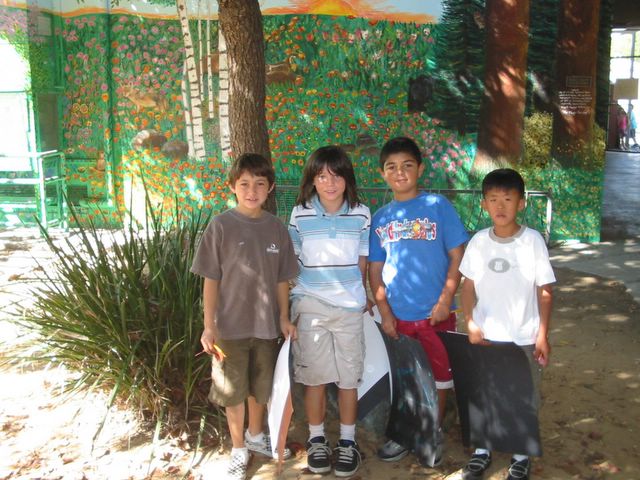
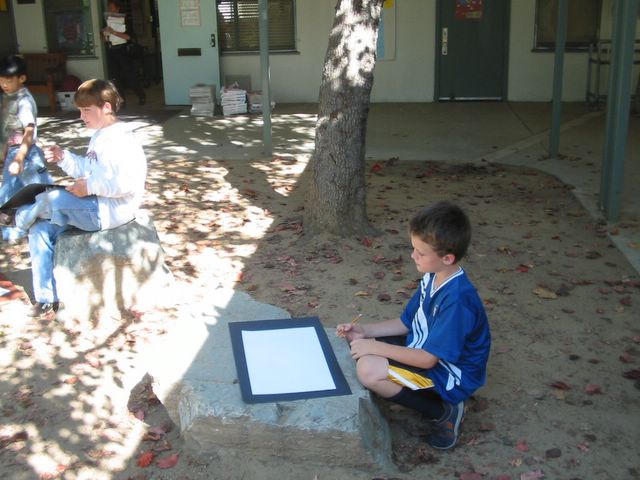
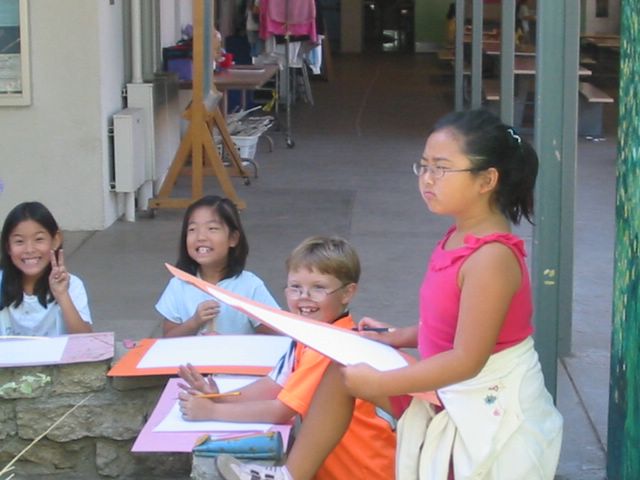
After that, we took an early recess and then went to the Mary Levin Courtyard near the office for an art lesson. The teacher, Mrs. Jones, is from the Barnsdall Art Center and her expert services are paid for by Friends of Third. She had the children working in “plein aire” drawing and painting pictures of the cactus and succulents in that wonderful space. You can see some of these pictures above.
In the afternoon, I had to go to Epi-pen training. That is, if you are unfamiliar with it, the medication given to students who have violent allergic reactions to foods. One of our children has such an allergy to peanuts. While I did this, Mrs. Caruso did the CELDT testing with some students, while the others have Phys Ed activities on the yard with Ms. Yoon.
Homework: Students had a chance to start on all these assignments in the morning while I was doing the oral testing. (1) Extended Form worksheet. (2) Addition and Subtraction worksheet. (3) Multiplying by Threes, pages 123-124, #3-38.
Today many of our students had to take the CELDT test. This stands for “California English Language Development Test.” We give this state-mandated assessment each year to all students who come from families where English is not the only language spoken. I worked with students individually in the morning to test speaking skills. Mrs. Caruso took those same students in the afternoon and gave them the writing and reading and listening sections. It’s an easy test, and generally our students do quite well on it. You will get the results in several months if your child took the test.
After that, we took an early recess and then went to the Mary Levin Courtyard near the office for an art lesson. The teacher, Mrs. Jones, is from the Barnsdall Art Center and her expert services are paid for by Friends of Third. She had the children working in “plein aire” drawing and painting pictures of the cactus and succulents in that wonderful space. You can see some of these pictures above.
In the afternoon, I had to go to Epi-pen training. That is, if you are unfamiliar with it, the medication given to students who have violent allergic reactions to foods. One of our children has such an allergy to peanuts. While I did this, Mrs. Caruso did the CELDT testing with some students, while the others have Phys Ed activities on the yard with Ms. Yoon.
Homework: Students had a chance to start on all these assignments in the morning while I was doing the oral testing. (1) Extended Form worksheet. (2) Addition and Subtraction worksheet. (3) Multiplying by Threes, pages 123-124, #3-38.
Thursday, October 06, 2005
Macaroni Math
Today we tried to really grasp the meaning of multiplication. It’s easy for students to learn a few of their multiplication facts, but it’s surprising how many have difficulty grasping what multiplication really means. They may know that 4 times 3 is 12, but they do not understand that this means that there are four groups of three and that this is the same as three groups of four. Lacking this understanding, they simply have no idea when to multiply instead of adding.
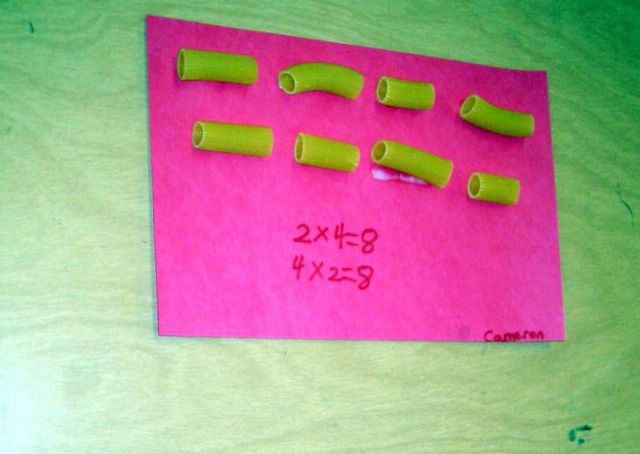
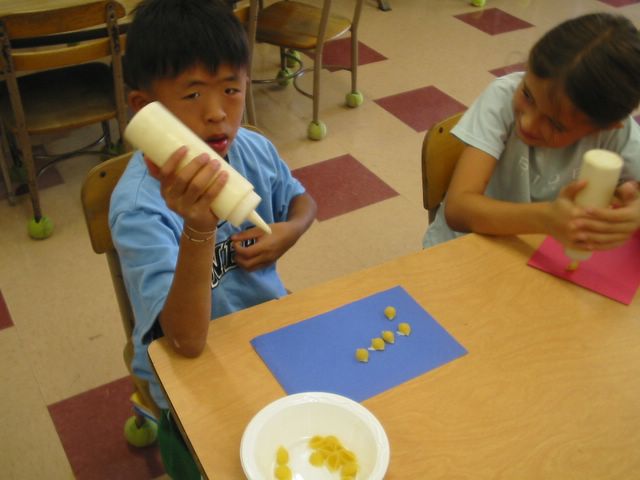
To help remedy this, we made arrays today. An array is a visual way to represent a multiplication fact. We used macaroni and glue and construction paper, and we had a pretty good time with it! You can see a picture of one of these below. It also helps students to grasp the commutative, or order property of multiplication. This way they can SEE that 4 x 5 and 5 x 4 are just different ways to state the same idea.
Homework: (1) Spelling. Test tomorrow! Study hard. (2) Science questions, page A 57. Please copy the question as well as answering. (3) Arrays, Math, page 121.
To help remedy this, we made arrays today. An array is a visual way to represent a multiplication fact. We used macaroni and glue and construction paper, and we had a pretty good time with it! You can see a picture of one of these below. It also helps students to grasp the commutative, or order property of multiplication. This way they can SEE that 4 x 5 and 5 x 4 are just different ways to state the same idea.
Homework: (1) Spelling. Test tomorrow! Study hard. (2) Science questions, page A 57. Please copy the question as well as answering. (3) Arrays, Math, page 121.
Wednesday, October 05, 2005

Base Eight
One of our activities each day, as we start math, is to count the days of the school year. This is a classic kindergarten, first grade activity, but we give it a special twist in room 19 by adding counting in Roman numerals and in Base 8.
I think that just like you never really understand the structure of your own language until you can compare and contrast it with the structure of another, only by learning other number systems will students really grasp our number system in its wondrous simplicity and in its astonishing complexity. Roman numerals certainly help the student understand the brilliance of using only 10 digits in the Hindu-Arabic system to write all possible number. Imagine trying to subtract MMCMDLVII from MMMMXXII. It’s a headache even to consider the possibility!
But Base 8 helps the students to really grasp the place value concept better. By eliminating the digits 8 and 9, students have to imagine a world where things are counted
1, 2, 3, 4, 5, 7, 10, 11, 12, and so forth.
It enchants them and fries their brains at the same time.
Today we took that counting a little further and we started to subtract and add in Base 8. At first, students wanted to use their existing Base 10 number facts. For example, they wanted to tell me that 11 – 3 was 8. But then I reminded them that this digit didn’t exist in that number system, and they had to create number lines to learn that in Base 8 the answer is 6!
Homework: (1) Study spelling. (2) Dog and Leopard study questions. (3) Multiplication by 2 and 5, pages 118-119.
I think that just like you never really understand the structure of your own language until you can compare and contrast it with the structure of another, only by learning other number systems will students really grasp our number system in its wondrous simplicity and in its astonishing complexity. Roman numerals certainly help the student understand the brilliance of using only 10 digits in the Hindu-Arabic system to write all possible number. Imagine trying to subtract MMCMDLVII from MMMMXXII. It’s a headache even to consider the possibility!
But Base 8 helps the students to really grasp the place value concept better. By eliminating the digits 8 and 9, students have to imagine a world where things are counted
1, 2, 3, 4, 5, 7, 10, 11, 12, and so forth.
It enchants them and fries their brains at the same time.
Today we took that counting a little further and we started to subtract and add in Base 8. At first, students wanted to use their existing Base 10 number facts. For example, they wanted to tell me that 11 – 3 was 8. But then I reminded them that this digit didn’t exist in that number system, and they had to create number lines to learn that in Base 8 the answer is 6!
Homework: (1) Study spelling. (2) Dog and Leopard study questions. (3) Multiplication by 2 and 5, pages 118-119.
Monday, October 03, 2005
Times Tables
A most pleasant day! The students were just wonderful.
We began reading one of my favorite Open Court stories today, "How Dog Outwitted Leopard." This Ugandan folktale explains how and why dogs decided to keep company with human beings. The students understood the subtle point of the tale: dogs are just plain smarter than people because they get us to do everything for them! I certainly work long hours so my dog can have a nice place to live.
We started multiplication today. Students now cover a good deal of this in second grade, and so the basic idea that multiplication is repeated addition is not new to them. But the struggle this year will be moving from that fairly easy insight to real mastery of the facts. Five minutes every day of flash cards will make this happen better than anything else. It will be easy to get students to a point where they can figure out the right answer if given sufficient time. But the amazing short cut that multiplication creates, and the way that it also simplifies what we do in mental math and estimation -- well, none of that works unless they really know the facts COLD.
Homework: (1) Study spelling words. (2) Science questions, page A47, numbers 1-4 only. (3) Math, page 116-117. We started this one in class, and discussed all the problems on the page which have caused confusion in the past.
We began reading one of my favorite Open Court stories today, "How Dog Outwitted Leopard." This Ugandan folktale explains how and why dogs decided to keep company with human beings. The students understood the subtle point of the tale: dogs are just plain smarter than people because they get us to do everything for them! I certainly work long hours so my dog can have a nice place to live.
We started multiplication today. Students now cover a good deal of this in second grade, and so the basic idea that multiplication is repeated addition is not new to them. But the struggle this year will be moving from that fairly easy insight to real mastery of the facts. Five minutes every day of flash cards will make this happen better than anything else. It will be easy to get students to a point where they can figure out the right answer if given sufficient time. But the amazing short cut that multiplication creates, and the way that it also simplifies what we do in mental math and estimation -- well, none of that works unless they really know the facts COLD.
Homework: (1) Study spelling words. (2) Science questions, page A47, numbers 1-4 only. (3) Math, page 116-117. We started this one in class, and discussed all the problems on the page which have caused confusion in the past.
Thursday, September 29, 2005
It's too Darn Hot!
Thursdays are my piano lesson days, so I usually rush right home. So it’s the briefest of posts today. It’s almost too hot to read, anyhow.
It may seem like there's a lot of homework below, but the students had ample time to start on all of these things in class. With the ferocious temperatures, we skipped as much of the outdoors stuff today as we could.
Homework: (1) Study spelling. Test is tomorrow over all 30 words. (2) Complete the two paragraphs comparing Leah and Chrissy's tree houses. Use the Thinking Map we created together in class. The first paragraph should discuss the similarities; the second should note the differences. (3) Do the Tree House study sheet. Be sure to answer the questions in complete sentences. (4) Do Review/Test page 70 and Cumulative Review, page 71. (5) Students should have completed pages 1-4 in the Cursive book.
It may seem like there's a lot of homework below, but the students had ample time to start on all of these things in class. With the ferocious temperatures, we skipped as much of the outdoors stuff today as we could.
Homework: (1) Study spelling. Test is tomorrow over all 30 words. (2) Complete the two paragraphs comparing Leah and Chrissy's tree houses. Use the Thinking Map we created together in class. The first paragraph should discuss the similarities; the second should note the differences. (3) Do the Tree House study sheet. Be sure to answer the questions in complete sentences. (4) Do Review/Test page 70 and Cumulative Review, page 71. (5) Students should have completed pages 1-4 in the Cursive book.
Wednesday, September 28, 2005
Mens sana in corpore sano
That famous Latin phrase means “A healthy mind in a healthy body.” We worked on this a little today as we began our first health lesson. We had a remarkably productive time.
I admit that I never have taught health much before because we never had any materials for it – other than some absurdly inadequate stuff about drug education – and I always just decided that PE was close enough to health education.
But this year the state provided us with new, and, at least at first glance, comprehensive health textbooks so I decided I would be a better health teacher. With that in mind, we pulled out the books for and started to read.
At first the students could not have been less interested. The body language was abundantly clear about that. But I decided to keep going anyhow, and, all of a sudden, the discussion exploded. They began to share all kinds of great ideas about what made for healthy minds and bodies. It was particularly fascinating when they began to discuss healthy relationships. One student made a point that being “too nice” could be unhealthy. Another student strongly disagreed, and we had a good conversation about when “nice” became “too nice” and it was annoying or worse.
Homework has been heavy the last couple days. Mea culpa. It should be lighter tonight. Remember to review the difference between an expression and a number sentence. See page 68 in the textbook.
Homework: (1) Study spelling. (2) Do "Estimate or Exact Answer, " Math, page 67. (3) Do "Expressions and Number Sentences," Math, page 69. (4) Cursive book, page 3.
I admit that I never have taught health much before because we never had any materials for it – other than some absurdly inadequate stuff about drug education – and I always just decided that PE was close enough to health education.
But this year the state provided us with new, and, at least at first glance, comprehensive health textbooks so I decided I would be a better health teacher. With that in mind, we pulled out the books for and started to read.
At first the students could not have been less interested. The body language was abundantly clear about that. But I decided to keep going anyhow, and, all of a sudden, the discussion exploded. They began to share all kinds of great ideas about what made for healthy minds and bodies. It was particularly fascinating when they began to discuss healthy relationships. One student made a point that being “too nice” could be unhealthy. Another student strongly disagreed, and we had a good conversation about when “nice” became “too nice” and it was annoying or worse.
Homework has been heavy the last couple days. Mea culpa. It should be lighter tonight. Remember to review the difference between an expression and a number sentence. See page 68 in the textbook.
Homework: (1) Study spelling. (2) Do "Estimate or Exact Answer, " Math, page 67. (3) Do "Expressions and Number Sentences," Math, page 69. (4) Cursive book, page 3.
Tuesday, September 27, 2005

Hands-On Equations
It may seem like the math students are getting lately is a little schizophrenic. On one hand, they have the most traditional kind of addition and subtraction practice, and, on the other, they have some weird assignments which asks them to figure out numbers by wildly guessing.
The choice of topics and approaches here is dictated by the District. Teachers are now given an “instructional guide” – it used to be called, more accurately, a “pacing plan” – and told what topics should be taught in what order. To make sure we follow it, students are given tests every quarter on the topics that are mandated in the instructional guide. Teachers are given some suggestions as to the assignments, but we really have a fair amount of latitude here.
Now, I’d change a few of the details of this plan, and I’m not always the biggest fan of the quarterly tests, but I think there’s a lot of good thinking behind it. That’s more than I can say for some other not-to-be-named district curriculum innovations.
Kids need to know the techniques – what mathematics teachers call “algorithms – for solving arithmetic problems. And the need some practice at this to get good at it. I do not think I was insistent enough about this at the start of this unit, and I think that much of the blame for the low scores can be laid, alas, at my feet. That’s why I’m giving them the worksheets now and demanding to see the work, not just the answers.
But more important than this, students need to learn to start thinking like mathematicians. And mathematicians play around with numbers and get fascinated by patterns. They learn patience as they approach problems in different ways.
To help the children think like mathematicians, but still have fun, we have a program called “Hands-on Equations.” This program is widely used not only in LAUSD, but throughout the country. It allows students to learn to understand the basic concepts of algebras – variables and equations – using a bunch of little plastic game piece and number cubes. There are 30 basic lessons. Really, lessons 11 and above only make sense to middle school students. But the earlier lessons, particularly 1 through 7, work well with children as young as third grade.
We did lesson 1 today. I think that a few of the students really got the idea. More will get it when we do the second lesson, probably towards the end of next month. I’ll showcase a bit of the program at the Back-to-School Breakfast.
Homework: (1) Study spelling. (2) Do crossword puzzle. (3) Addition and subtraction worksheet. (4) Page 2 of cursive book.
The choice of topics and approaches here is dictated by the District. Teachers are now given an “instructional guide” – it used to be called, more accurately, a “pacing plan” – and told what topics should be taught in what order. To make sure we follow it, students are given tests every quarter on the topics that are mandated in the instructional guide. Teachers are given some suggestions as to the assignments, but we really have a fair amount of latitude here.
Now, I’d change a few of the details of this plan, and I’m not always the biggest fan of the quarterly tests, but I think there’s a lot of good thinking behind it. That’s more than I can say for some other not-to-be-named district curriculum innovations.
Kids need to know the techniques – what mathematics teachers call “algorithms – for solving arithmetic problems. And the need some practice at this to get good at it. I do not think I was insistent enough about this at the start of this unit, and I think that much of the blame for the low scores can be laid, alas, at my feet. That’s why I’m giving them the worksheets now and demanding to see the work, not just the answers.
But more important than this, students need to learn to start thinking like mathematicians. And mathematicians play around with numbers and get fascinated by patterns. They learn patience as they approach problems in different ways.
To help the children think like mathematicians, but still have fun, we have a program called “Hands-on Equations.” This program is widely used not only in LAUSD, but throughout the country. It allows students to learn to understand the basic concepts of algebras – variables and equations – using a bunch of little plastic game piece and number cubes. There are 30 basic lessons. Really, lessons 11 and above only make sense to middle school students. But the earlier lessons, particularly 1 through 7, work well with children as young as third grade.
We did lesson 1 today. I think that a few of the students really got the idea. More will get it when we do the second lesson, probably towards the end of next month. I’ll showcase a bit of the program at the Back-to-School Breakfast.
Homework: (1) Study spelling. (2) Do crossword puzzle. (3) Addition and subtraction worksheet. (4) Page 2 of cursive book.
Monday, September 26, 2005
The Theater's the Thing
Today we did our first theater arts lesson. Theater is a very powerful tool in the language arts classroom, and the teachers in the district's arts program have given us some simple but powerful lessons to develop the skills the students will need in this area.
After doing our usual blending and dictation practice, and, after a quick review of the Priscilla story, students quietly found their "space bubble" in the room. A space bubble is what we call an area of personal space big enough for safe movement. We discussed the the fact that actors really only have three tools to create their art: their bodies, their voices, and, above all, their imaginations. We set out to explore these dimensions.
We began with making statues. Students were asked to "shake into" statues which showed different emotions such as happiness, anger, or depression. This used the tools of the body and the imagination. We then explored the voice as a tool by using gibberish, another classic theater game. The children used gibberish to tell about their weekends. This combined the voice and the imagination.
Finally, we put all three elements together by creating machines in groups of three to five. Machine, like gibberish, is a classic theater game which requires the students to observe what the others are doing and to figure out a way to cooperate. Each group performed for the class, and students were asked to guess what they thought each machine might might be. I wish my batteries hadn't died in my digital camera: the machines were often quite clever!
Homework: (1) Study spelling words. (2) Finish the Priscilla study sheet. Be sure to give complete sentence answers. (3) Do page 1 in the cursive book. This will be checked on Friday. (4) Do the addition and subtraction worksheet. Be sure to show all work. Students had a chance to start this in class. (5) Do the "Getting Ready for Algebra" sheet on the back of the addition and subtraction paper.
This may seem like a lot of work tonight, but as I said on Friday, we have to review and continue at the same time. And students also had a fair amount of time to get started on these papers earlier.
After doing our usual blending and dictation practice, and, after a quick review of the Priscilla story, students quietly found their "space bubble" in the room. A space bubble is what we call an area of personal space big enough for safe movement. We discussed the the fact that actors really only have three tools to create their art: their bodies, their voices, and, above all, their imaginations. We set out to explore these dimensions.
We began with making statues. Students were asked to "shake into" statues which showed different emotions such as happiness, anger, or depression. This used the tools of the body and the imagination. We then explored the voice as a tool by using gibberish, another classic theater game. The children used gibberish to tell about their weekends. This combined the voice and the imagination.
Finally, we put all three elements together by creating machines in groups of three to five. Machine, like gibberish, is a classic theater game which requires the students to observe what the others are doing and to figure out a way to cooperate. Each group performed for the class, and students were asked to guess what they thought each machine might might be. I wish my batteries hadn't died in my digital camera: the machines were often quite clever!
Homework: (1) Study spelling words. (2) Finish the Priscilla study sheet. Be sure to give complete sentence answers. (3) Do page 1 in the cursive book. This will be checked on Friday. (4) Do the addition and subtraction worksheet. Be sure to show all work. Students had a chance to start this in class. (5) Do the "Getting Ready for Algebra" sheet on the back of the addition and subtraction paper.
This may seem like a lot of work tonight, but as I said on Friday, we have to review and continue at the same time. And students also had a fair amount of time to get started on these papers earlier.
Friday, September 23, 2005
Math Test
On Thursday the students took their first math test of the year. Although one student made a perfect score, most were pretty disappointing. Here were the typical mistakes:
This means that some students will be having heavier than usual homework in math, at least for a while. But once we have had some more practice on these kinds of problems, I will retest students who need it. We will then either drop the first test or average the two tests together while weighting the second one more.
Homework: Students were given 10 math problems to do on Friday afternoon. They had to copy the problems out and do all the work. Most finished in class, but a few took them home to finish.
- Many students did not consistently regroup when they added. Generally I do not think they did not understand what to do, but they were trying to do the problems in their heads without using scratch paper. We will need to spend time discussing when mental math is appropriate, and when it is a bad idea.
- Estimation is still pretty shaky for many students. Some just ignore the direction to estimate altogether and find the exact answer. Others get a little puzzled about what to do when the number is somewhere around 5. We will continue to work on this.
- A consistent issue was with those problems which require pre-Algebraic thinking. Here would be a typical example. “Jack has 35 pencils and pens. He has 5 more pencils than pens. How many pencils does he have? How many pens?” This word problem is based on the algebraic equation x + (x + 5) = 35. Students will later learn to subtract the 5 from both sides of the equation and then to figure out 2x = 30 and then x=15. Based on that, they can figure out that Jack has 15 pens and 20 pencils. However, students are not quite ready for that yet, and we also want to foster at this time a certain playfulness with numbers. So we encourage them to use a “guess and check” strategy and to try substituting different numbers and see what works. We want them to get away from finding the answer instantly because, however satisfying that may be, it isn’t what mathematics is really about. There will be some more problems like this in the future.
- Related to kind of problem above are the “sum and difference” problem. Again, here’s a typical example. “Two numbers have a sum of 25. They have a difference of 5. What are the two numbers?” Again, this is really algebra: x + y = 25 and x – y = 5. The goal again is to have students play around with different number combinations until they find ones that work. Again, more problems like this will appear as homework.
This means that some students will be having heavier than usual homework in math, at least for a while. But once we have had some more practice on these kinds of problems, I will retest students who need it. We will then either drop the first test or average the two tests together while weighting the second one more.
Homework: Students were given 10 math problems to do on Friday afternoon. They had to copy the problems out and do all the work. Most finished in class, but a few took them home to finish.
Thursday, September 22, 2005
Being Out is NOT Much Fun!
Having a substitute teacher may seems like a day off, but as just about any teacher will tell you it’s a lot more work than being there. You need to write out things for another person that you’d never need to write out for yourself, and make everything simple enough that you think the person could not possibly mess it up.
I would so much rather have been with the children today. One of my many duties at school is being the Art Program chair. I inherited this when Jim Anderson left for his new job as a math coach. So today we had a meeting where we sat there for about six hours to get about 45 minutes of new information.
I’m looking forward to seeing everybody tomorrow again. I feel pretty confident that they probably had a very productive day with Ms. Choo.
Homework: I gave the substitute a fair bit of leeway in deciding what needed to be done in class and what could go home. Today you’ll need to trust the little one!
I would so much rather have been with the children today. One of my many duties at school is being the Art Program chair. I inherited this when Jim Anderson left for his new job as a math coach. So today we had a meeting where we sat there for about six hours to get about 45 minutes of new information.
I’m looking forward to seeing everybody tomorrow again. I feel pretty confident that they probably had a very productive day with Ms. Choo.
Homework: I gave the substitute a fair bit of leeway in deciding what needed to be done in class and what could go home. Today you’ll need to trust the little one!
Wednesday, September 21, 2005
Reading and Thinking
For the most part, third grade is a joy to teach. The children have a little more awareness of the world around them than they did in first and second grades, and many are starting to develop a sense of humor. But there’s a few rude shocks which await them in third grade. We all know about cursive and multiplication. But reading has its surprises, too, particularly for those who thought they had it all down.
Reading at heart is a thinking activity. We use reading as a tool to improve our knowledge of the world and to gain specific needed information. Even when reading fiction, we use what we already know about the real world to help make sense of the fictional world.
But for students entering third grade, reading has been mostly about sounding out words. Students have not really been challenged to use what they already know to understand a text, nor are they accustomed to making inferences from the text or basing critical judgments on the text. It’s been all about getting the word right.
Now we pull the rug out from underneath them and say, “Sure you can say the words. But what do they mean? Explain it in your own language.” And most of them are completely baffled.
That’s a good description of our work in Reading this morning. We discussed drawing conclusions, the way Open Court terms making inferences. And they were positively baffled at the answers I was hoping to get from them because they just were not there on the page where they could be right or wrong.
The good news here is that our third graders are not unusual. This happens to all children this age, even those who are supposed to be “gifted.” Learning to think while reading takes time, and though it seems hard or even weird to them right now it will in time beyond second nature.
I’ll be gone to a district meeting tomorrow. We have a nice substitute lined up who was a teacher in her own classroom for many years. I’m sure the kids will be fabulous and have an excellent day.
Homework: (1) Study spelling for Friday’s test. (2) Review chapter 3 in the math book as needed. There will be a test tomorrow. (3) Do “Synonyms and Antonyms,” pp. 25-26 in the Reading and Writing Workbook. (4) Subtraction, p. 60 in the Math book, numbers 2-26 only. Do not worry about estimating right now.
Reading at heart is a thinking activity. We use reading as a tool to improve our knowledge of the world and to gain specific needed information. Even when reading fiction, we use what we already know about the real world to help make sense of the fictional world.
But for students entering third grade, reading has been mostly about sounding out words. Students have not really been challenged to use what they already know to understand a text, nor are they accustomed to making inferences from the text or basing critical judgments on the text. It’s been all about getting the word right.
Now we pull the rug out from underneath them and say, “Sure you can say the words. But what do they mean? Explain it in your own language.” And most of them are completely baffled.
That’s a good description of our work in Reading this morning. We discussed drawing conclusions, the way Open Court terms making inferences. And they were positively baffled at the answers I was hoping to get from them because they just were not there on the page where they could be right or wrong.
The good news here is that our third graders are not unusual. This happens to all children this age, even those who are supposed to be “gifted.” Learning to think while reading takes time, and though it seems hard or even weird to them right now it will in time beyond second nature.
I’ll be gone to a district meeting tomorrow. We have a nice substitute lined up who was a teacher in her own classroom for many years. I’m sure the kids will be fabulous and have an excellent day.
Homework: (1) Study spelling for Friday’s test. (2) Review chapter 3 in the math book as needed. There will be a test tomorrow. (3) Do “Synonyms and Antonyms,” pp. 25-26 in the Reading and Writing Workbook. (4) Subtraction, p. 60 in the Math book, numbers 2-26 only. Do not worry about estimating right now.
Subscribe to:
Posts (Atom)