It was a busy day! Mondays usually are. But it was a great day, too. And Mondays usually are that, as well.
We began a new story in Open Court today called “Urban Roosts.” This is another fairly long nonfiction selection. It explores how different kinds of birds have adapted to life in the city. It’s an interesting but challenging selection. We’ll be having a lot of fun with it this week, exploring the ideas in the selection in art and dance as well as answering questions and other usual activities.
We also have been doing a lot in the past week to connect this theme of City Wildlife to both our Writer’s Workshop and to technology. Mrs. Gassman and Mr. Benitez have been helping me with Reader’s Workshop conferences so that I can work each day with a small group of students on their HyperStudio stacks on City Wildlife. As the children get to know this powerful program better, they will need less support from me. Right now, I’m really pleased at how well they’re doing.
After lunch we had a district-mandated “lockdown drill.” This simulated what students would have to do in the extremely unlikely event of some kind of serious police activity in the neighborhood. The students did very well and stayed very calm – and very polite, too, as some of the adults involved talked endlessly….
Homework: (1) Study spelling. (2) Complete the Urban Roosts crossword puzzle. We started this one in class. (3) Do “Multiply by 8,” Math, page 153, all problems.
Monday, November 14, 2005


Thursday, November 10, 2005
Have a Great Weekend
Students had substantial time to start the following assignments in class, and many completed most or all of them. If they did not, please complete them this weekend.
Homework: (1) Do “Multiply by 7,” Math, pages 150-151, numbers 2-37. (2) Copy and complete vocabulary sentences, page A110, numbers 1-12 only. (3) Do the Alphabetical Order worksheet. (4) Do the spelling wordsearch. (5) Complete pages 5-8 in the Cursive writing book.
Homework: (1) Do “Multiply by 7,” Math, pages 150-151, numbers 2-37. (2) Copy and complete vocabulary sentences, page A110, numbers 1-12 only. (3) Do the Alphabetical Order worksheet. (4) Do the spelling wordsearch. (5) Complete pages 5-8 in the Cursive writing book.
Tuesday, November 08, 2005
Dr Zipper's Orchestra
Sorry for the late post. I have to go to a funeral tomorrow in San Diego, and I was a little overwhelmed getting ready for the substitute.
Other than the endless meeting with the literacy "coach" after the children had left, I had a remarkably good time in school today, and I think the students did, too. I worked with a group during reading time to help them more with their HyperStudio stacks we started yesterday. Mrs. Gassman helped me out with reading conferences. Integrating technology into the curriculum this way is very exciting. It is time-consuming, however, and that sometimes makes us teachers shy away from it. Mr. Benitez helped the children review and correct their math homework. I worked with them on phonics with the long o sound. Then we rushed off to our new auditorium to hear Dr. Zipper's orchestra.
What a fabulous experience! Now the the Colburn School is offering conservatory level classes for university degrees, Dr. Zipper's orchestra is now filled with energetic talented young musicians. The ensemble was crisp and the playing energetic. The children seemed to instinctively know that this time it was good, and they sat back and absorbed a challenging program including Bartok and Shostakovich. Wow!
We did our videos of the Rhythmic Machines, and they were fantastic! They will definitely be included on the end-of-the-year DVD. We also read a little about desert environment. After lunch, we did another Second Step lesson which catches us up with where I wanted to be in this program. From now on, this will be a Thursday afternoon activity.
Homework: (1) Study spelling. (2) Do the "Boy who didn't Believe in Spring" study questions. (3) Finish the Algebra and Geometry review sheets. Tomorrow is the Quarter One math test.
Other than the endless meeting with the literacy "coach" after the children had left, I had a remarkably good time in school today, and I think the students did, too. I worked with a group during reading time to help them more with their HyperStudio stacks we started yesterday. Mrs. Gassman helped me out with reading conferences. Integrating technology into the curriculum this way is very exciting. It is time-consuming, however, and that sometimes makes us teachers shy away from it. Mr. Benitez helped the children review and correct their math homework. I worked with them on phonics with the long o sound. Then we rushed off to our new auditorium to hear Dr. Zipper's orchestra.
What a fabulous experience! Now the the Colburn School is offering conservatory level classes for university degrees, Dr. Zipper's orchestra is now filled with energetic talented young musicians. The ensemble was crisp and the playing energetic. The children seemed to instinctively know that this time it was good, and they sat back and absorbed a challenging program including Bartok and Shostakovich. Wow!
We did our videos of the Rhythmic Machines, and they were fantastic! They will definitely be included on the end-of-the-year DVD. We also read a little about desert environment. After lunch, we did another Second Step lesson which catches us up with where I wanted to be in this program. From now on, this will be a Thursday afternoon activity.
Homework: (1) Study spelling. (2) Do the "Boy who didn't Believe in Spring" study questions. (3) Finish the Algebra and Geometry review sheets. Tomorrow is the Quarter One math test.
Monday, November 07, 2005
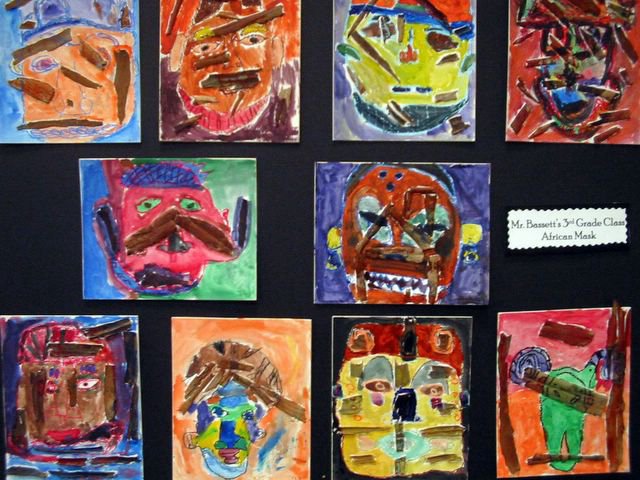
Some of our African masks which were on display in the auditorium on Sunday for the grand reopening reception. If you haven't seen this sparking space, stop by the auditorium soon.
Posted by Picasa

A very generous parent in our class donated a color laser printer to the school. Through the network it will be available for other classes to use, but it will be housed in room 19! Thank you!
Posted by Picasa
HyperStudio
We had a most pleasant Monday.
Today we started on a new story in Reading called “The Boy who didn’t Believe in Spring.” It’s a strange tale of a child named King Shabazz and his friend Tony Polito. These two boys seem to live in someplace like the Bronx. King claims he does not believe there is any such thing as spring. But when he’s told that it’s just around the corner, he decides to literally go around the corner in search of spring. In doing so, he finds signs of spring – flowering bulbs and a robin’s nest – in an abandoned car in a vacant lot.
We also did more work on our Machine composition. Today we planned how the machine would malfunction, and groups showed us their machines using only the Kodaly syllables and motions. Tomorrow we’ll add instruments. In Tech Center, we started on a major project in HyperStudio. For those of you unfamiliar with this application, HyperStudio is a multimedia authoring system for presenting information. Text and pictures are put on electronic “cards” which are then dynamically linked to other cards to move around the “stack.” It’s a little challenging program for third graders, but our students are more than up to it! Mr. Merkelson was quite pleased by how well they did.
In PE, we practice kicking using a kind of relay game. It was fun, though some of the goalies gave a little more help than they should have…. Math is review for the quarter test which will be on Wednesday.
Homework: (1) Study spelling list 10. (2) Finish the rough draft on the second city plant or animal. (3) Do the math packet. They had ample time to start this in class.
Today we started on a new story in Reading called “The Boy who didn’t Believe in Spring.” It’s a strange tale of a child named King Shabazz and his friend Tony Polito. These two boys seem to live in someplace like the Bronx. King claims he does not believe there is any such thing as spring. But when he’s told that it’s just around the corner, he decides to literally go around the corner in search of spring. In doing so, he finds signs of spring – flowering bulbs and a robin’s nest – in an abandoned car in a vacant lot.
We also did more work on our Machine composition. Today we planned how the machine would malfunction, and groups showed us their machines using only the Kodaly syllables and motions. Tomorrow we’ll add instruments. In Tech Center, we started on a major project in HyperStudio. For those of you unfamiliar with this application, HyperStudio is a multimedia authoring system for presenting information. Text and pictures are put on electronic “cards” which are then dynamically linked to other cards to move around the “stack.” It’s a little challenging program for third graders, but our students are more than up to it! Mr. Merkelson was quite pleased by how well they did.
In PE, we practice kicking using a kind of relay game. It was fun, though some of the goalies gave a little more help than they should have…. Math is review for the quarter test which will be on Wednesday.
Homework: (1) Study spelling list 10. (2) Finish the rough draft on the second city plant or animal. (3) Do the math packet. They had ample time to start this in class.
Friday, November 04, 2005
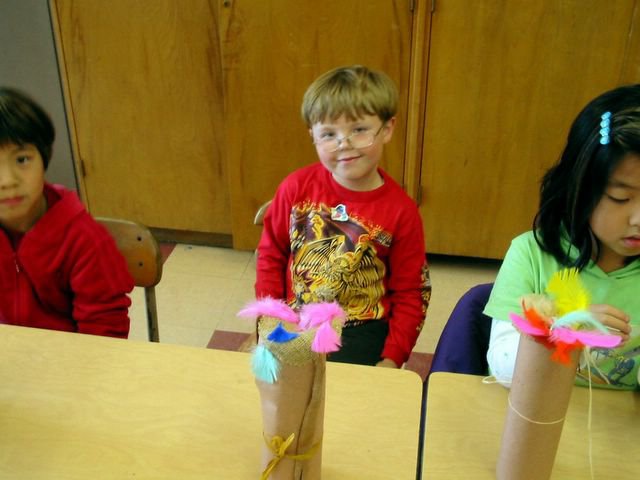
Patience and Perseverance
Fridays have a special feel in a classroom. They bring the week to a close, and as such are good days for tests and other forms of evaluation. This creates a certain seriousness about the day. At the same time, many students already have special plans for the weekend. This can lead to a barely-concealed, almost giddy excitement. I think we felt all those feelings today.
After silent reading, we finished the chapter 5 test. This is one of the toughest ones in the book, despite the fact that money ought to be a relatively easy and accessible topic. Every third grade teacher has noticed this. Part of this difficulty is the fact that some of the children are still pretty weak on addition and subtraction with regrouping. More of the problem comes from the idea of equivalent sets. Now students get the idea that 2 quarters are equal to 5 dimes. They understand that these are equivalent sets. But when we ask them to find as many sets as possible for a specified amount of money -- say 35 cents -- the puzzle aspect of this problem seems to elude them.
And yet, approaching math as a puzzle, figuring out systematically all kinds of possibilities, is a lot more important to their long-term growth in mathematics than merely answering multiplication problems quickly. Children like right answers right away. But in our modern world that kind of math has been relegated to machines which can do it faster than we ever can. People are still needed, though, for careful, thoughtful problem solving. And this requires patience and perseverance, qualities that few children seem to have, particularly in our over-stimulated, plugged-in, multi-tasking age.
Fortunately, there are many ways to develop these characteristics, and Visual Art projects are particularly good. There is, after all, no way to complete a complex art assignment instantly, and children seem to understand that. So providing them with interesting and complex art assignment, and creating an atmosphere of serious concentration, does a great deal to develop patience and perseverance. I certainly noticed that yesterday when we did our leaf paintings. Today's art project was done with the Barnsdall art teacher. She has some wonderful projects that she does with the children, all of which require thoughtfulness and concentration. I would approach teaching some of these differently than she does, but I appreciate her expertise in some areas. Today the children made totem poles out of plastic bottles, construction paper, burlap, and other media. This took a lot of effort, a lot of concentration. In the picture above, you can see a smile coming from a job well done.
In the afternoon, we worked some more on rhythmic machine. This is a tough project because it works on so many skills at once. Carl Orff said, "Let the children be their own composers." Easier said than done, Mr. Orff! Composition is a real important skill for children, but it creates a lot of management challenges in the classroom. It is so much easier to simply present the students with one prepared piece for them to learn. And yet a process of improvisation, composition, practice, and performance creates so much long-term growth that it is worth risking the noise and confusion. We made a lot of progress. But we have more to do.
Homework: Homework for children will return Monday. Have a good weekend. I hope to see everybody Sunday at the auditorium rededication.
After silent reading, we finished the chapter 5 test. This is one of the toughest ones in the book, despite the fact that money ought to be a relatively easy and accessible topic. Every third grade teacher has noticed this. Part of this difficulty is the fact that some of the children are still pretty weak on addition and subtraction with regrouping. More of the problem comes from the idea of equivalent sets. Now students get the idea that 2 quarters are equal to 5 dimes. They understand that these are equivalent sets. But when we ask them to find as many sets as possible for a specified amount of money -- say 35 cents -- the puzzle aspect of this problem seems to elude them.
And yet, approaching math as a puzzle, figuring out systematically all kinds of possibilities, is a lot more important to their long-term growth in mathematics than merely answering multiplication problems quickly. Children like right answers right away. But in our modern world that kind of math has been relegated to machines which can do it faster than we ever can. People are still needed, though, for careful, thoughtful problem solving. And this requires patience and perseverance, qualities that few children seem to have, particularly in our over-stimulated, plugged-in, multi-tasking age.
Fortunately, there are many ways to develop these characteristics, and Visual Art projects are particularly good. There is, after all, no way to complete a complex art assignment instantly, and children seem to understand that. So providing them with interesting and complex art assignment, and creating an atmosphere of serious concentration, does a great deal to develop patience and perseverance. I certainly noticed that yesterday when we did our leaf paintings. Today's art project was done with the Barnsdall art teacher. She has some wonderful projects that she does with the children, all of which require thoughtfulness and concentration. I would approach teaching some of these differently than she does, but I appreciate her expertise in some areas. Today the children made totem poles out of plastic bottles, construction paper, burlap, and other media. This took a lot of effort, a lot of concentration. In the picture above, you can see a smile coming from a job well done.
In the afternoon, we worked some more on rhythmic machine. This is a tough project because it works on so many skills at once. Carl Orff said, "Let the children be their own composers." Easier said than done, Mr. Orff! Composition is a real important skill for children, but it creates a lot of management challenges in the classroom. It is so much easier to simply present the students with one prepared piece for them to learn. And yet a process of improvisation, composition, practice, and performance creates so much long-term growth that it is worth risking the noise and confusion. We made a lot of progress. But we have more to do.
Homework: Homework for children will return Monday. Have a good weekend. I hope to see everybody Sunday at the auditorium rededication.
Thursday, November 03, 2005

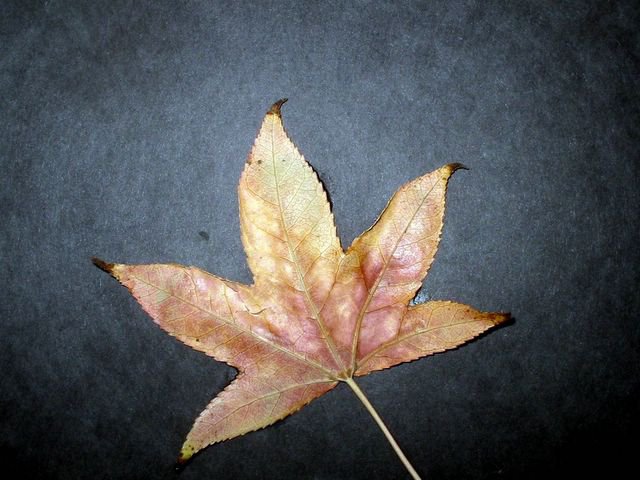
A very atmospheric leaf painting. Most were more realistic, but I liked the colors here.
Posted by Picasa

Just Another Day in Paradise
If the days keep being this wonderful, I’m going to have to PAY to be a teacher!
Today we did leaf paintings in our Open Court time. You’ll see an example of one above. It was an activity which helped them really observe nature closely -- an important Science skill, too – and connect all this “City Lots” stuff to their own urban environment. We will be putting up the paintings next to the actual leaf, so stop by the classroom next week for a look!
After recess, we discussed Forest ecosystems, discussing the similarities and differences among the four major types of forests: deciduous forests, tropical rain forests, temperate rain forests, and coniferous forests. After that, we continued with the music machine project. Today, we took a really had step and started to notate our rhythms. We used both the traditional note values and the Kodaly syllables here. Again, you can see an example above.
In the afternoon, we did another Second Step lesson. This one was done in small rotating groups. I worked with each group discussing a picture situation, while Mr. Benitez worked with each group doing role plays. It went really, really well! We’ll be doing this again next week, and we give you some pictures of the role plays in action. Mr. Benitez did an awesome job!
Homework: Light night tonight. Study spelling for the test tomorrow, and if you know anything is not completed, work on that, too.
Today we did leaf paintings in our Open Court time. You’ll see an example of one above. It was an activity which helped them really observe nature closely -- an important Science skill, too – and connect all this “City Lots” stuff to their own urban environment. We will be putting up the paintings next to the actual leaf, so stop by the classroom next week for a look!
After recess, we discussed Forest ecosystems, discussing the similarities and differences among the four major types of forests: deciduous forests, tropical rain forests, temperate rain forests, and coniferous forests. After that, we continued with the music machine project. Today, we took a really had step and started to notate our rhythms. We used both the traditional note values and the Kodaly syllables here. Again, you can see an example above.
In the afternoon, we did another Second Step lesson. This one was done in small rotating groups. I worked with each group discussing a picture situation, while Mr. Benitez worked with each group doing role plays. It went really, really well! We’ll be doing this again next week, and we give you some pictures of the role plays in action. Mr. Benitez did an awesome job!
Homework: Light night tonight. Study spelling for the test tomorrow, and if you know anything is not completed, work on that, too.
Wednesday, November 02, 2005
Wonderful Wednesday
Just an all around great day! We had particular fun doing relays at PE. Maybe not as much fun doing our Math test, but the results look pretty good. Check the gradebook as I will post results fairly soon.
Homework: (1) Study spelling. (2) Do the "City Lots" study questions. Be sure to copy the vocabulary sentences and to answer the others in complete sentences. We discussed each question in class and located the answers in the book. (3) Using the Circle Map we created in class, write a rough draft of a descriptive paragraph about sycamore trees. Be sure to have a topic sentence and lots of supporting details. Also, skip lines for easier correcting! (4) Do the chapter 5 review, pages 90-91. Equivalent sets are just similar coins with the same value here: 2 dimes and 1 nickel, 4 nickels and 5 pennies are equivalent sets.
ALSO, this is VERY IMPORTANT! Bring a largish leaf, preferably mostly green or yellow and red rather than already brown, for a favorite art activity tomorrow.
Homework: (1) Study spelling. (2) Do the "City Lots" study questions. Be sure to copy the vocabulary sentences and to answer the others in complete sentences. We discussed each question in class and located the answers in the book. (3) Using the Circle Map we created in class, write a rough draft of a descriptive paragraph about sycamore trees. Be sure to have a topic sentence and lots of supporting details. Also, skip lines for easier correcting! (4) Do the chapter 5 review, pages 90-91. Equivalent sets are just similar coins with the same value here: 2 dimes and 1 nickel, 4 nickels and 5 pennies are equivalent sets.
ALSO, this is VERY IMPORTANT! Bring a largish leaf, preferably mostly green or yellow and red rather than already brown, for a favorite art activity tomorrow.
Tuesday, November 01, 2005
Second Step
Today was a great day, despite all the dire warnings some parents gave me about a “sugar high.” We started on one of the toughest stories in the Open Court series, a nonfiction selection called “City Lots.” This essay explains how children can see nature changing in vacant, trash-filled lots in their neighborhood. Of course, you can probably see that with land values being what they are in our area, there aren’t too many vacant lots! Plus, the selection has them looking for all kinds of trees and plants which may be common in Brooklyn, but are not in Southern California. There’s a lot of tough vocabulary in the selection, as well as the difficult content. We spent more of our time with this story trying to define all the unfamiliar words. We made an elaborate wall of word definitions on the white board. All of these words are the ones that show up in the crossword tonight.
After lunch, we started on the Second Step program. This is a district-approved approach to teaching students social skills and conflict resolution skills. It involves discussing situations which are portrayed in cards or on videos and then in using role-play and writing to practice the skills and to reflect on how to handle similar situations. I used to program at a former school, and the students generally enjoyed it and we had some good discussions. This will be a regular Tuesday activity for us.
Homework: (1) Study spelling. (2) Complete the crossword puzzle. (3) Do Review/Test, Math, page 392, and Cumulative Review, Math, page 393.
After lunch, we started on the Second Step program. This is a district-approved approach to teaching students social skills and conflict resolution skills. It involves discussing situations which are portrayed in cards or on videos and then in using role-play and writing to practice the skills and to reflect on how to handle similar situations. I used to program at a former school, and the students generally enjoyed it and we had some good discussions. This will be a regular Tuesday activity for us.
Homework: (1) Study spelling. (2) Complete the crossword puzzle. (3) Do Review/Test, Math, page 392, and Cumulative Review, Math, page 393.
Monday, October 31, 2005
Happy Halloween
A quick post here today, since you're all probably getting ready for trick or treating. We had a very pleasant day. It was nice to be back with the class. We finished up some odds and ends on the City Critters story, and the last section of the OCR test. We worked on environments in the Tech Center, and worked on Machine in Arts.
Spencer's mom provided us with a lovely Halloween feast. The kids were great and really appreciative. In math we discussed "tessellation", a less arcane concept than its name, and we also reviewed our work from Friday.
Homework: (1) Study spelling. (2) Tessellation, Math, pages 388-389, numbers 1-9, 13-20.
Spencer's mom provided us with a lovely Halloween feast. The kids were great and really appreciative. In math we discussed "tessellation", a less arcane concept than its name, and we also reviewed our work from Friday.
Homework: (1) Study spelling. (2) Tessellation, Math, pages 388-389, numbers 1-9, 13-20.
Thursday, October 27, 2005
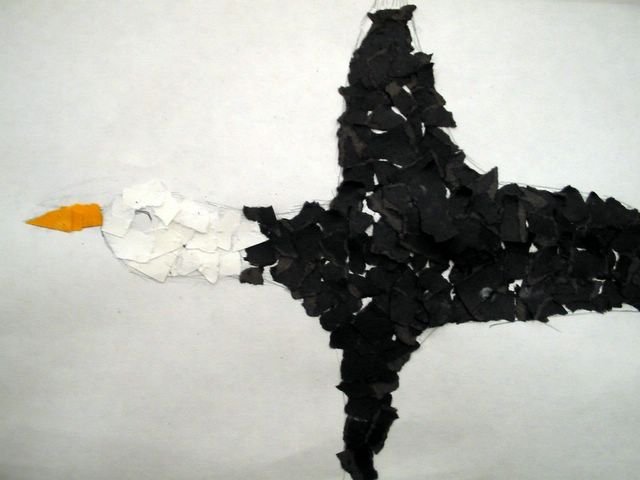
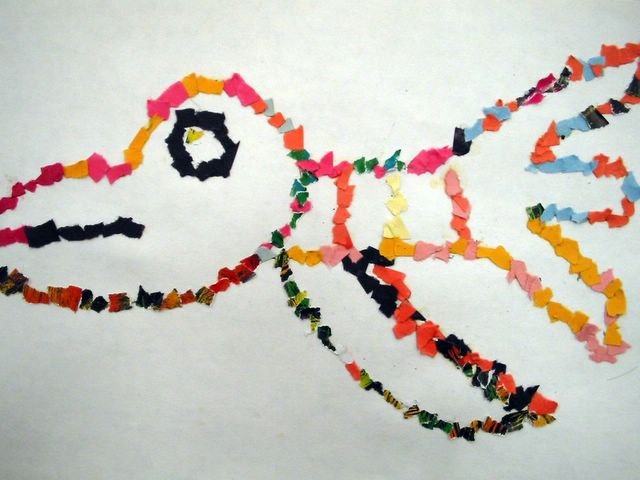
A Mosaic of Learning
Today we integrated our Visual Arts skills into Open Court. Since the students have been starting to study City Wildlife, we made some pictures of some of these plants and animals. However, instead of simply drawing them, we used torn paper to make mosaics of the wildlife. This required the students to really concentrate for an extended period of time on a fairly detailed work. They did quite well! It’s not an easy assignment.
We continued our work in Music today by learning the Kodaly names for the different rhythmic notes: quarter note, for example, is “ta”, and two eighth notes are “ti ti”. They grasped this really quickly after we had practiced it with the rhythm of the classic “Teddy Bear, Teddy Bear” jump rope chant.
In Science, we looked at ecosystems. There’s a lot of hard vocabulary here for the students, but the ideas behind those words are very important. In Math, we turned our attention to congruence and symmetry of plane figures. I never studied this stuff in third grade. I’m glad these guys are so smart!
Homework: (1) Study spelling. (2) Science questions, page A83, numbers 1-4. (3) Congruence and Symmetry, Math, pages 385-387, numbers 2-21 and 23-24. (4) Adding and Subtracting Money worksheet.
We continued our work in Music today by learning the Kodaly names for the different rhythmic notes: quarter note, for example, is “ta”, and two eighth notes are “ti ti”. They grasped this really quickly after we had practiced it with the rhythm of the classic “Teddy Bear, Teddy Bear” jump rope chant.
In Science, we looked at ecosystems. There’s a lot of hard vocabulary here for the students, but the ideas behind those words are very important. In Math, we turned our attention to congruence and symmetry of plane figures. I never studied this stuff in third grade. I’m glad these guys are so smart!
Homework: (1) Study spelling. (2) Science questions, page A83, numbers 1-4. (3) Congruence and Symmetry, Math, pages 385-387, numbers 2-21 and 23-24. (4) Adding and Subtracting Money worksheet.
Wednesday, October 26, 2005
Picture Day
The best thing about Picture Day is probably that it’s another year until the next Picture Day. There’s so much waiting in line, and the kids get so restless. It’s definitely worse than the doctor’s office, since there are no magazines to read. It’s probably even worse than the DMV. Still, I think everybody probably took a nice picture, and this seemed like the most competent company we’ve had in years. You should be receiving some nice photos.
We filled up the rest of the day with usual Wednesday activities. We did some work in phonics and language. We worked on different kinds of plurals some more. We went to the library. We took a science test. We had PE. We talked about polygons in math and we had some fun drawing different types of polygons.
Homework: (1) Study spelling. (2) Making Change, Math, page 87, all problems. (3) Polygons, pages 382-383, numbers 1-20 and 22-26. Students should also be finishing their polygon drawings if they did not do this in class.
We filled up the rest of the day with usual Wednesday activities. We did some work in phonics and language. We worked on different kinds of plurals some more. We went to the library. We took a science test. We had PE. We talked about polygons in math and we had some fun drawing different types of polygons.
Homework: (1) Study spelling. (2) Making Change, Math, page 87, all problems. (3) Polygons, pages 382-383, numbers 1-20 and 22-26. Students should also be finishing their polygon drawings if they did not do this in class.
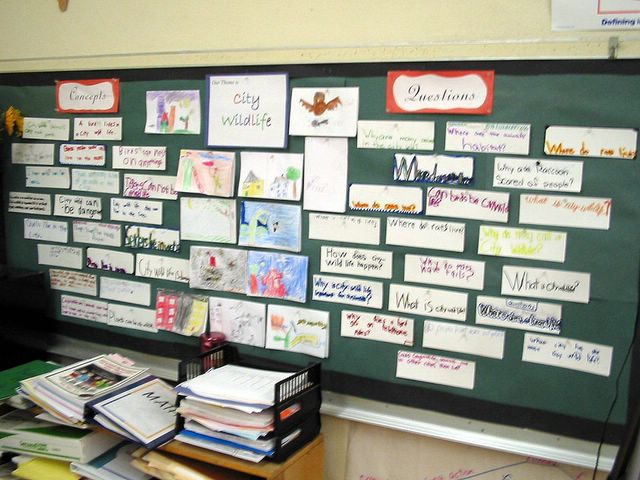
We worked yesterday on determining what we already knew and what we wanted to learn about City Wildlife. Putting these together, we created our Concept / Question board. Thanks, Mr. Benitez, for putting it up so beautifully!
Posted by Picasa

Tuesday, October 25, 2005
Short Tuesdays
Today was the first short Tuesday. A torture for teachers who have to endure a weekly meeting, but a joy for students who have an hour more of liberty. At least until they get bored. . . .
Be sure to remember that tomorrow is picture day. Be sure to look all spiffy!
Homework: (1) Spelling. (2) City Critters study questions. (3) Monday, page 89, problems 2-27. Be sure to copy 2 through 18. The rest can be answers only.
Be sure to remember that tomorrow is picture day. Be sure to look all spiffy!
Homework: (1) Spelling. (2) City Critters study questions. (3) Monday, page 89, problems 2-27. Be sure to copy 2 through 18. The rest can be answers only.
Monday, October 24, 2005
Gray-t Day
Wasn't it cold and gray and bleak today? Fortunately, the sun came out inside room 19 and we had a nice day inside. We did most of the rest of the OCR unit 1 test. Results will be on the gradebook soon. We finally did the Marco Polo video today and we went to the Tech Center.
In the afternoon we worked on Health instead of our usual PE. We read a chapter on self-concept, and then composed poems about growing up. It's a free verse assignment, and each line contains the words "I used to . . . , but now I . . . ." We'll post a couple of these on the blog in a day or two.
Homework: (1) Study spelling. (2) Complete the plurals worksheet, if not finished in the morning. (3) Complete the rough and final drafts of the "I used to" poem. A few finished this in class. (4) Review, Math, pages 378-379.
In the afternoon we worked on Health instead of our usual PE. We read a chapter on self-concept, and then composed poems about growing up. It's a free verse assignment, and each line contains the words "I used to . . . , but now I . . . ." We'll post a couple of these on the blog in a day or two.
Homework: (1) Study spelling. (2) Complete the plurals worksheet, if not finished in the morning. (3) Complete the rough and final drafts of the "I used to" poem. A few finished this in class. (4) Review, Math, pages 378-379.
Thursday, October 20, 2005
Nice Day
We had a very peaceful, ordinary day today. How pleasant routine can be in a classroom!
We did some review for the spelling portion of the Open Court test, and we did the first draft of our composition on a "Memorable Time I Spent with a Friend", the assigned topic for the writing portion of the exam. So far most of them look pretty good. We also had a blast in Music as we turned our Marco Polo poem into a two-part percussion piece and then improvised dance phrases to go with it. We'll videotape it tomorrow for the end-of-the-year DVD.
In the afternoon, we did the chapter 8 math test. Results are posted on the gradebook.
Homework: (1) Study spelling for the test tomorrow. (2) Crossword puzzle. We started this in class and discussed strategies. Pay particular attention to the number of letters for each answer and check the word box for answers of that length. (3) Types of Lines, Math, pages 372-373, 1-12 only.
We did some review for the spelling portion of the Open Court test, and we did the first draft of our composition on a "Memorable Time I Spent with a Friend", the assigned topic for the writing portion of the exam. So far most of them look pretty good. We also had a blast in Music as we turned our Marco Polo poem into a two-part percussion piece and then improvised dance phrases to go with it. We'll videotape it tomorrow for the end-of-the-year DVD.
In the afternoon, we did the chapter 8 math test. Results are posted on the gradebook.
Homework: (1) Study spelling for the test tomorrow. (2) Crossword puzzle. We started this in class and discussed strategies. Pay particular attention to the number of letters for each answer and check the word box for answers of that length. (3) Types of Lines, Math, pages 372-373, 1-12 only.
Wednesday, October 19, 2005
Just Plane Hard
There are some things that you learn to just dread as a third grade teacher. Introducing children to plane geometry is one of them.
Students get the idea of the three dimensional shapes even when they have weird names like “rectangular prism.” But the two-dimensional world is different. All of a sudden we’re telling them that them that the thing they always called a line isn’t a line but a “segment” and that there are they need to be able to distinguish between angles that are bigger or smaller than right angles – it tends to alternatively bore and befog the eight year old mind.
So homework may be hard tonight. We tried our best to talk about it today, but it was hard for them to wrap their minds around it.
Homework: (1) Continue to study spelling. (2) Science book, page A75, questions 24-27. (3) Lines and Angles, Math, pages 369-371, numbers 1-25. (4) Review/Test, Math, pages 144 and Cumulative Review, Math page 145.
Students get the idea of the three dimensional shapes even when they have weird names like “rectangular prism.” But the two-dimensional world is different. All of a sudden we’re telling them that them that the thing they always called a line isn’t a line but a “segment” and that there are they need to be able to distinguish between angles that are bigger or smaller than right angles – it tends to alternatively bore and befog the eight year old mind.
So homework may be hard tonight. We tried our best to talk about it today, but it was hard for them to wrap their minds around it.
Homework: (1) Continue to study spelling. (2) Science book, page A75, questions 24-27. (3) Lines and Angles, Math, pages 369-371, numbers 1-25. (4) Review/Test, Math, pages 144 and Cumulative Review, Math page 145.
Tuesday, October 18, 2005


Better!
Maybe it was me, but today did not seem was a endless yesterday did. We began with silent reading, and then went on to discuss the homework at length. We talked about the four types of sentences – statements, questions, exclamations, and commands – and started on a worksheet about this. These items are on the district’s Open Court unit one test, so we want them to be well-prepared for it.
After inside recess, we work on haiku poems. You can see one example of these above. Students not only wrote their haikus about the rain, but illustrated them in watercolor. Many were quite lovely.
We did manage to get out today at lunch recess. That was good for my mental health! After this lovely play break, we did more review on life forms and habitats. This is a particularly confusing part of the chapter review, so we did it together. We then turned our attention to math. Students actually finished most of the work in class. We concentrated on patterns in numbers and in combining solid forms. They’re really getting the basics of solid geometry here. Plane geometry, soon to follow, will be a bit more mentally challenging….
Thanks for all the parents who have turned in emergency kits. Please send yours ASAP if you have not turned it in yet.
Homework: (1) Continue to study spelling. (2) Finish the worksheets on Exclamation and Statements. There was a lot of time to work on this today, so many students are already done with it. (3) Patterns, Math, page 137, numbers 1-9. (4) Combine Figures, Math, page 367, numbers 2-20. If students did not get any of the work done from yesterday for today because there was some confusion, they can work on it tonight and turn it in tomorrow.
After inside recess, we work on haiku poems. You can see one example of these above. Students not only wrote their haikus about the rain, but illustrated them in watercolor. Many were quite lovely.
We did manage to get out today at lunch recess. That was good for my mental health! After this lovely play break, we did more review on life forms and habitats. This is a particularly confusing part of the chapter review, so we did it together. We then turned our attention to math. Students actually finished most of the work in class. We concentrated on patterns in numbers and in combining solid forms. They’re really getting the basics of solid geometry here. Plane geometry, soon to follow, will be a bit more mentally challenging….
Thanks for all the parents who have turned in emergency kits. Please send yours ASAP if you have not turned it in yet.
Homework: (1) Continue to study spelling. (2) Finish the worksheets on Exclamation and Statements. There was a lot of time to work on this today, so many students are already done with it. (3) Patterns, Math, page 137, numbers 1-9. (4) Combine Figures, Math, page 367, numbers 2-20. If students did not get any of the work done from yesterday for today because there was some confusion, they can work on it tonight and turn it in tomorrow.

Late Post
Sorry for the very, very late post. I was so preoccupied with finishing the GATE proposal and turning it in, and then starting on the Arts Education budget, that I forgot all about blogging the homework.
If students are missing something because of my mistake, then they can take some extra time to make it up.
Homework: (1) Study spelling. (2) Vocabulary Review, Science, page A74, questions 1-14 only. Please copy the sentences. (3) Solid Forms, Math, pages 363-363, number 1-20. (4) Find Missing Factors, Math, page 142, numbers 2-28.
If students are missing something because of my mistake, then they can take some extra time to make it up.
Homework: (1) Study spelling. (2) Vocabulary Review, Science, page A74, questions 1-14 only. Please copy the sentences. (3) Solid Forms, Math, pages 363-363, number 1-20. (4) Find Missing Factors, Math, page 142, numbers 2-28.
Friday, October 14, 2005
Page Museum Trip
Today we have a great time at the Page Museum, despite the heat. The children did a great job of walking over to the park. I’ve never had so little complaining. This is most fit group of third grade students I’ve ever taught.
At the museum, our guide was a retired dentist. He was remarkably patient, as 80 year old former dentists go. Not surprising, however, he did point out the teeth of every fossil we saw. That did help us to determine whether they were carnivores or herbivores. None of them apparently flossed which could explain their demise.
Homework: (1) Write a good paragraph about your trip to the Page Museum today. Use the cluster we made in class today. Finish the rough draft we started, and then have some capable person check it before doing the final draft. Finally, do a good color picture. (2) Multiplication practice, math, pages 139-131, problems 2-46, 49-60.
Thursday, October 13, 2005
Tomorrow
I hope everyone is having a great day off. It looks like tomorrow will be warm, though not so warm as today, so please wear light colors, loose-fitting clothes, and comfortable shoes. Remember to bring a sack lunch tomorrow with something to drink. Soomi’s mom has volunteered to drive lunches over to the park, though I’m sure she’d love some help. We have a couple moms who have already volunteered to walk with us, but more would be fine.
Remember, if you have not yet turned in the permission slips, we need them by tomorrow morning first thing.
See you tomorrow.
Remember, if you have not yet turned in the permission slips, we need them by tomorrow morning first thing.
See you tomorrow.
Wednesday, October 12, 2005
Changes
A pleasantly disoriented day. Everything got a little switched around for the students, but they did just fine.
Because we have our field trip on Friday, we had to reschedule Art for the afternoon. That meant we needed to do math in the morning. You may think this is no big deal, but for third graders routine is very important! Math in the morning is sort of just plain wrong for them. Nevertheless, they did splendidly on the multiplication test. Check the gradebook for the scores if you did not already get an email.
We had library at the usual time, then took an early lunch. First lunch instead of third. First graders instead of fifth graders. I'm sure they sort of liked being the biggest kids on the yard. The art lady from Barnsdall came at 12:30 and she pretty much took up the rest of the day doing a bark project with them. It's not quite finished yet, so you'll see examples of their work next week.
If you have not yet signed the permission slip, get it back Friday so your child can go with us! We need the medical release on the second page as well as the Page Museum part.
Homework: (1) Study spelling. (2) Math, page 133 - all problems. (3) Math, pages 134-145, problems 2-43.
Because we have our field trip on Friday, we had to reschedule Art for the afternoon. That meant we needed to do math in the morning. You may think this is no big deal, but for third graders routine is very important! Math in the morning is sort of just plain wrong for them. Nevertheless, they did splendidly on the multiplication test. Check the gradebook for the scores if you did not already get an email.
We had library at the usual time, then took an early lunch. First lunch instead of third. First graders instead of fifth graders. I'm sure they sort of liked being the biggest kids on the yard. The art lady from Barnsdall came at 12:30 and she pretty much took up the rest of the day doing a bark project with them. It's not quite finished yet, so you'll see examples of their work next week.
If you have not yet signed the permission slip, get it back Friday so your child can go with us! We need the medical release on the second page as well as the Page Museum part.
Homework: (1) Study spelling. (2) Math, page 133 - all problems. (3) Math, pages 134-145, problems 2-43.
Tuesday, October 11, 2005
Things change
Today we began our day with our annual Back-to-School Breakfast. We had a pretty good turnout from our families. If you were not able to come this morning, please ask your child for the packet we gave to the parents this morning. It has some important stuff in it, including the permission slip for this Friday’s field trip. Please get that signed so your child can go!
The field trip will be to the Page Museum by the La Brea Tar Pits. This fits in perfectly with our Science unit where we are studying habitats, animal populations, and extinction. We read about extinction in the book today, and we have a great conversation about the different causes of animals going extinct.
Speaking of how things change, our final reading selection in the Friendship unit is called “Teammates.” It’s a lot harder than the other selections, but far, far better written. It tells the story of the friendship between Jackie Robinson and Pee Wee Reese. The story is not only about friendship, but about the wrong of racial prejudice and segregation. It gives our students some really hard things to grapple with, but they are doing a good job of thinking about some really hard ideas and ugly realities. It also gives us a chance to contrast the American of the 1950’s with that of today and to see that at least in some ways, things are better now.
A big thank you to the parents who contributed to the Wish List. We took in enough to pay for all the requested musical instruments, though there are a number of items unclaimed on the PE equipment list.
Homework: (1) Complete the study questions on Teammates. We went over all the questions in class, so it should be simply an exercise in writing complete sentence answers. Also, students had close to 40 minutes to work on this. (2) Contractions, Reading and Writing Workbook, pages 47-48. Again, they had time to start this in class and many may already have finished. (3) Math, Chapter Test and Cumulative Review, pages 128-129.
The field trip will be to the Page Museum by the La Brea Tar Pits. This fits in perfectly with our Science unit where we are studying habitats, animal populations, and extinction. We read about extinction in the book today, and we have a great conversation about the different causes of animals going extinct.
Speaking of how things change, our final reading selection in the Friendship unit is called “Teammates.” It’s a lot harder than the other selections, but far, far better written. It tells the story of the friendship between Jackie Robinson and Pee Wee Reese. The story is not only about friendship, but about the wrong of racial prejudice and segregation. It gives our students some really hard things to grapple with, but they are doing a good job of thinking about some really hard ideas and ugly realities. It also gives us a chance to contrast the American of the 1950’s with that of today and to see that at least in some ways, things are better now.
A big thank you to the parents who contributed to the Wish List. We took in enough to pay for all the requested musical instruments, though there are a number of items unclaimed on the PE equipment list.
Homework: (1) Complete the study questions on Teammates. We went over all the questions in class, so it should be simply an exercise in writing complete sentence answers. Also, students had close to 40 minutes to work on this. (2) Contractions, Reading and Writing Workbook, pages 47-48. Again, they had time to start this in class and many may already have finished. (3) Math, Chapter Test and Cumulative Review, pages 128-129.
Monday, October 10, 2005
See You Tomorrow!
Just a quick post as I hope to see everybody tomorrow at our Back-to-School Breakfast event. Remember, breakfast from 7:00 to 8:00, and our classroom presentation will be from 8:30 to 9:00.
Other than that, tomorrow will be a regular schedule day. Shortened days will begin on October 25.
Homework: (1) Spelling. (2) Math, page 127, #1-7. (3) Math, page H38 (found in the back of the math book).
Other than that, tomorrow will be a regular schedule day. Shortened days will begin on October 25.
Homework: (1) Spelling. (2) Math, page 127, #1-7. (3) Math, page H38 (found in the back of the math book).
Friday, October 07, 2005
Norm Day? Not Really
On the District calendar today is called “Norm Day” because as of this day all schools add or delete teachers as needed to make sure that the ratio of teachers and students falls within certain “norms.” Well, I have to chuckle a little here because there was nothing particularly “normal” about our “Norm Day” in room 19.
Today many of our students had to take the CELDT test. This stands for “California English Language Development Test.” We give this state-mandated assessment each year to all students who come from families where English is not the only language spoken. I worked with students individually in the morning to test speaking skills. Mrs. Caruso took those same students in the afternoon and gave them the writing and reading and listening sections. It’s an easy test, and generally our students do quite well on it. You will get the results in several months if your child took the test.
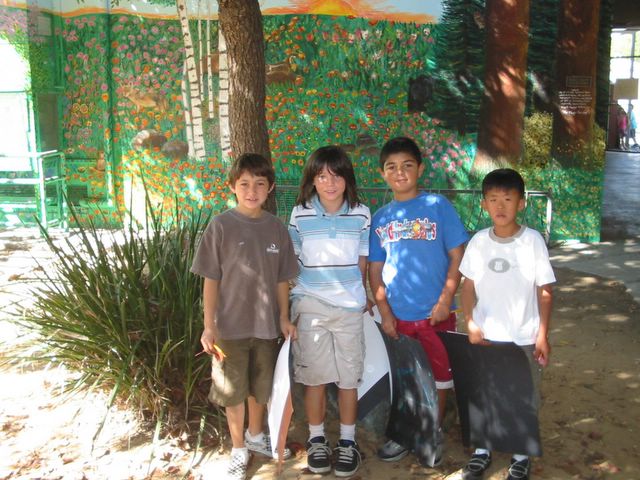
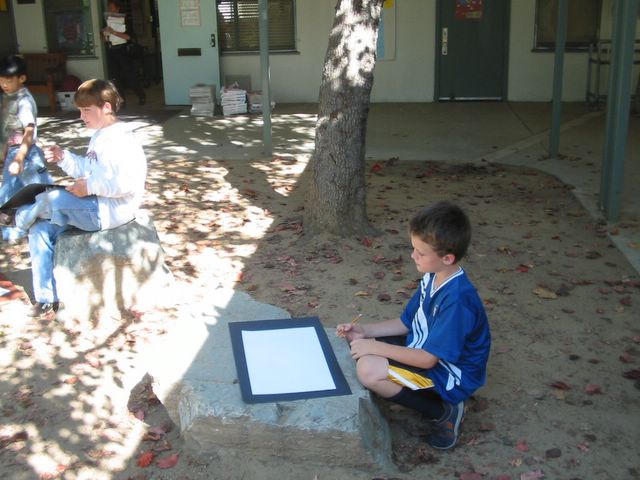
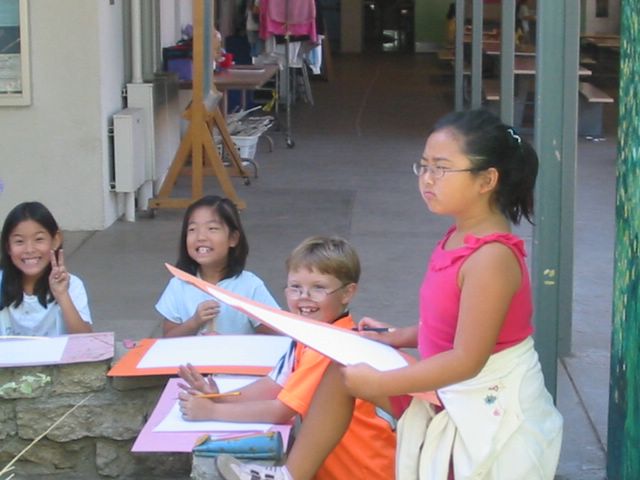
After that, we took an early recess and then went to the Mary Levin Courtyard near the office for an art lesson. The teacher, Mrs. Jones, is from the Barnsdall Art Center and her expert services are paid for by Friends of Third. She had the children working in “plein aire” drawing and painting pictures of the cactus and succulents in that wonderful space. You can see some of these pictures above.
In the afternoon, I had to go to Epi-pen training. That is, if you are unfamiliar with it, the medication given to students who have violent allergic reactions to foods. One of our children has such an allergy to peanuts. While I did this, Mrs. Caruso did the CELDT testing with some students, while the others have Phys Ed activities on the yard with Ms. Yoon.
Homework: Students had a chance to start on all these assignments in the morning while I was doing the oral testing. (1) Extended Form worksheet. (2) Addition and Subtraction worksheet. (3) Multiplying by Threes, pages 123-124, #3-38.
Today many of our students had to take the CELDT test. This stands for “California English Language Development Test.” We give this state-mandated assessment each year to all students who come from families where English is not the only language spoken. I worked with students individually in the morning to test speaking skills. Mrs. Caruso took those same students in the afternoon and gave them the writing and reading and listening sections. It’s an easy test, and generally our students do quite well on it. You will get the results in several months if your child took the test.
After that, we took an early recess and then went to the Mary Levin Courtyard near the office for an art lesson. The teacher, Mrs. Jones, is from the Barnsdall Art Center and her expert services are paid for by Friends of Third. She had the children working in “plein aire” drawing and painting pictures of the cactus and succulents in that wonderful space. You can see some of these pictures above.
In the afternoon, I had to go to Epi-pen training. That is, if you are unfamiliar with it, the medication given to students who have violent allergic reactions to foods. One of our children has such an allergy to peanuts. While I did this, Mrs. Caruso did the CELDT testing with some students, while the others have Phys Ed activities on the yard with Ms. Yoon.
Homework: Students had a chance to start on all these assignments in the morning while I was doing the oral testing. (1) Extended Form worksheet. (2) Addition and Subtraction worksheet. (3) Multiplying by Threes, pages 123-124, #3-38.
Thursday, October 06, 2005
Macaroni Math
Today we tried to really grasp the meaning of multiplication. It’s easy for students to learn a few of their multiplication facts, but it’s surprising how many have difficulty grasping what multiplication really means. They may know that 4 times 3 is 12, but they do not understand that this means that there are four groups of three and that this is the same as three groups of four. Lacking this understanding, they simply have no idea when to multiply instead of adding.
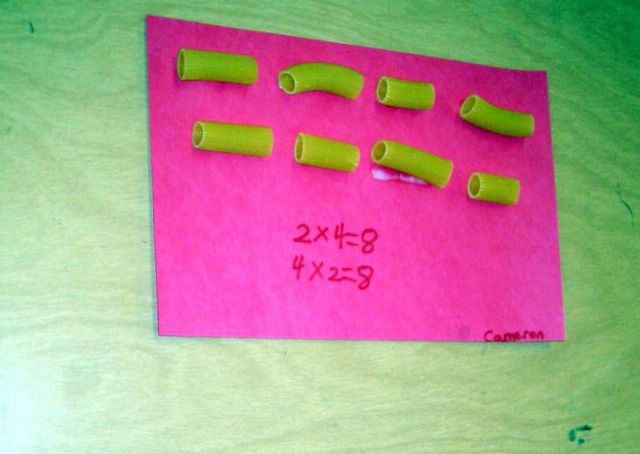
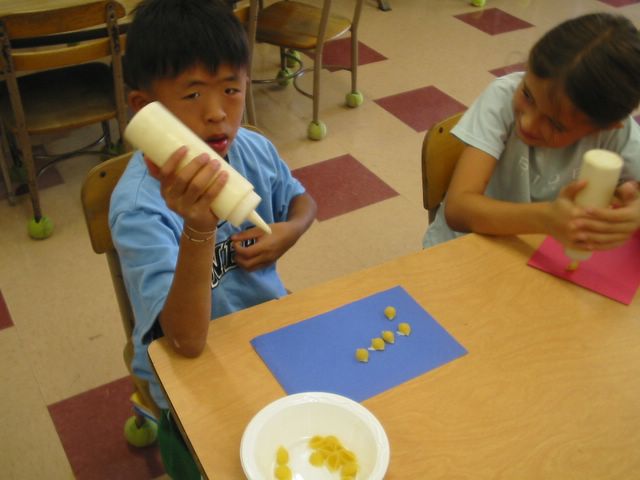
To help remedy this, we made arrays today. An array is a visual way to represent a multiplication fact. We used macaroni and glue and construction paper, and we had a pretty good time with it! You can see a picture of one of these below. It also helps students to grasp the commutative, or order property of multiplication. This way they can SEE that 4 x 5 and 5 x 4 are just different ways to state the same idea.
Homework: (1) Spelling. Test tomorrow! Study hard. (2) Science questions, page A 57. Please copy the question as well as answering. (3) Arrays, Math, page 121.
To help remedy this, we made arrays today. An array is a visual way to represent a multiplication fact. We used macaroni and glue and construction paper, and we had a pretty good time with it! You can see a picture of one of these below. It also helps students to grasp the commutative, or order property of multiplication. This way they can SEE that 4 x 5 and 5 x 4 are just different ways to state the same idea.
Homework: (1) Spelling. Test tomorrow! Study hard. (2) Science questions, page A 57. Please copy the question as well as answering. (3) Arrays, Math, page 121.
Wednesday, October 05, 2005

Base Eight
One of our activities each day, as we start math, is to count the days of the school year. This is a classic kindergarten, first grade activity, but we give it a special twist in room 19 by adding counting in Roman numerals and in Base 8.
I think that just like you never really understand the structure of your own language until you can compare and contrast it with the structure of another, only by learning other number systems will students really grasp our number system in its wondrous simplicity and in its astonishing complexity. Roman numerals certainly help the student understand the brilliance of using only 10 digits in the Hindu-Arabic system to write all possible number. Imagine trying to subtract MMCMDLVII from MMMMXXII. It’s a headache even to consider the possibility!
But Base 8 helps the students to really grasp the place value concept better. By eliminating the digits 8 and 9, students have to imagine a world where things are counted
1, 2, 3, 4, 5, 7, 10, 11, 12, and so forth.
It enchants them and fries their brains at the same time.
Today we took that counting a little further and we started to subtract and add in Base 8. At first, students wanted to use their existing Base 10 number facts. For example, they wanted to tell me that 11 – 3 was 8. But then I reminded them that this digit didn’t exist in that number system, and they had to create number lines to learn that in Base 8 the answer is 6!
Homework: (1) Study spelling. (2) Dog and Leopard study questions. (3) Multiplication by 2 and 5, pages 118-119.
I think that just like you never really understand the structure of your own language until you can compare and contrast it with the structure of another, only by learning other number systems will students really grasp our number system in its wondrous simplicity and in its astonishing complexity. Roman numerals certainly help the student understand the brilliance of using only 10 digits in the Hindu-Arabic system to write all possible number. Imagine trying to subtract MMCMDLVII from MMMMXXII. It’s a headache even to consider the possibility!
But Base 8 helps the students to really grasp the place value concept better. By eliminating the digits 8 and 9, students have to imagine a world where things are counted
1, 2, 3, 4, 5, 7, 10, 11, 12, and so forth.
It enchants them and fries their brains at the same time.
Today we took that counting a little further and we started to subtract and add in Base 8. At first, students wanted to use their existing Base 10 number facts. For example, they wanted to tell me that 11 – 3 was 8. But then I reminded them that this digit didn’t exist in that number system, and they had to create number lines to learn that in Base 8 the answer is 6!
Homework: (1) Study spelling. (2) Dog and Leopard study questions. (3) Multiplication by 2 and 5, pages 118-119.
Monday, October 03, 2005
Times Tables
A most pleasant day! The students were just wonderful.
We began reading one of my favorite Open Court stories today, "How Dog Outwitted Leopard." This Ugandan folktale explains how and why dogs decided to keep company with human beings. The students understood the subtle point of the tale: dogs are just plain smarter than people because they get us to do everything for them! I certainly work long hours so my dog can have a nice place to live.
We started multiplication today. Students now cover a good deal of this in second grade, and so the basic idea that multiplication is repeated addition is not new to them. But the struggle this year will be moving from that fairly easy insight to real mastery of the facts. Five minutes every day of flash cards will make this happen better than anything else. It will be easy to get students to a point where they can figure out the right answer if given sufficient time. But the amazing short cut that multiplication creates, and the way that it also simplifies what we do in mental math and estimation -- well, none of that works unless they really know the facts COLD.
Homework: (1) Study spelling words. (2) Science questions, page A47, numbers 1-4 only. (3) Math, page 116-117. We started this one in class, and discussed all the problems on the page which have caused confusion in the past.
We began reading one of my favorite Open Court stories today, "How Dog Outwitted Leopard." This Ugandan folktale explains how and why dogs decided to keep company with human beings. The students understood the subtle point of the tale: dogs are just plain smarter than people because they get us to do everything for them! I certainly work long hours so my dog can have a nice place to live.
We started multiplication today. Students now cover a good deal of this in second grade, and so the basic idea that multiplication is repeated addition is not new to them. But the struggle this year will be moving from that fairly easy insight to real mastery of the facts. Five minutes every day of flash cards will make this happen better than anything else. It will be easy to get students to a point where they can figure out the right answer if given sufficient time. But the amazing short cut that multiplication creates, and the way that it also simplifies what we do in mental math and estimation -- well, none of that works unless they really know the facts COLD.
Homework: (1) Study spelling words. (2) Science questions, page A47, numbers 1-4 only. (3) Math, page 116-117. We started this one in class, and discussed all the problems on the page which have caused confusion in the past.
Thursday, September 29, 2005
It's too Darn Hot!
Thursdays are my piano lesson days, so I usually rush right home. So it’s the briefest of posts today. It’s almost too hot to read, anyhow.
It may seem like there's a lot of homework below, but the students had ample time to start on all of these things in class. With the ferocious temperatures, we skipped as much of the outdoors stuff today as we could.
Homework: (1) Study spelling. Test is tomorrow over all 30 words. (2) Complete the two paragraphs comparing Leah and Chrissy's tree houses. Use the Thinking Map we created together in class. The first paragraph should discuss the similarities; the second should note the differences. (3) Do the Tree House study sheet. Be sure to answer the questions in complete sentences. (4) Do Review/Test page 70 and Cumulative Review, page 71. (5) Students should have completed pages 1-4 in the Cursive book.
It may seem like there's a lot of homework below, but the students had ample time to start on all of these things in class. With the ferocious temperatures, we skipped as much of the outdoors stuff today as we could.
Homework: (1) Study spelling. Test is tomorrow over all 30 words. (2) Complete the two paragraphs comparing Leah and Chrissy's tree houses. Use the Thinking Map we created together in class. The first paragraph should discuss the similarities; the second should note the differences. (3) Do the Tree House study sheet. Be sure to answer the questions in complete sentences. (4) Do Review/Test page 70 and Cumulative Review, page 71. (5) Students should have completed pages 1-4 in the Cursive book.
Wednesday, September 28, 2005
Mens sana in corpore sano
That famous Latin phrase means “A healthy mind in a healthy body.” We worked on this a little today as we began our first health lesson. We had a remarkably productive time.
I admit that I never have taught health much before because we never had any materials for it – other than some absurdly inadequate stuff about drug education – and I always just decided that PE was close enough to health education.
But this year the state provided us with new, and, at least at first glance, comprehensive health textbooks so I decided I would be a better health teacher. With that in mind, we pulled out the books for and started to read.
At first the students could not have been less interested. The body language was abundantly clear about that. But I decided to keep going anyhow, and, all of a sudden, the discussion exploded. They began to share all kinds of great ideas about what made for healthy minds and bodies. It was particularly fascinating when they began to discuss healthy relationships. One student made a point that being “too nice” could be unhealthy. Another student strongly disagreed, and we had a good conversation about when “nice” became “too nice” and it was annoying or worse.
Homework has been heavy the last couple days. Mea culpa. It should be lighter tonight. Remember to review the difference between an expression and a number sentence. See page 68 in the textbook.
Homework: (1) Study spelling. (2) Do "Estimate or Exact Answer, " Math, page 67. (3) Do "Expressions and Number Sentences," Math, page 69. (4) Cursive book, page 3.
I admit that I never have taught health much before because we never had any materials for it – other than some absurdly inadequate stuff about drug education – and I always just decided that PE was close enough to health education.
But this year the state provided us with new, and, at least at first glance, comprehensive health textbooks so I decided I would be a better health teacher. With that in mind, we pulled out the books for and started to read.
At first the students could not have been less interested. The body language was abundantly clear about that. But I decided to keep going anyhow, and, all of a sudden, the discussion exploded. They began to share all kinds of great ideas about what made for healthy minds and bodies. It was particularly fascinating when they began to discuss healthy relationships. One student made a point that being “too nice” could be unhealthy. Another student strongly disagreed, and we had a good conversation about when “nice” became “too nice” and it was annoying or worse.
Homework has been heavy the last couple days. Mea culpa. It should be lighter tonight. Remember to review the difference between an expression and a number sentence. See page 68 in the textbook.
Homework: (1) Study spelling. (2) Do "Estimate or Exact Answer, " Math, page 67. (3) Do "Expressions and Number Sentences," Math, page 69. (4) Cursive book, page 3.
Tuesday, September 27, 2005

Hands-On Equations
It may seem like the math students are getting lately is a little schizophrenic. On one hand, they have the most traditional kind of addition and subtraction practice, and, on the other, they have some weird assignments which asks them to figure out numbers by wildly guessing.
The choice of topics and approaches here is dictated by the District. Teachers are now given an “instructional guide” – it used to be called, more accurately, a “pacing plan” – and told what topics should be taught in what order. To make sure we follow it, students are given tests every quarter on the topics that are mandated in the instructional guide. Teachers are given some suggestions as to the assignments, but we really have a fair amount of latitude here.
Now, I’d change a few of the details of this plan, and I’m not always the biggest fan of the quarterly tests, but I think there’s a lot of good thinking behind it. That’s more than I can say for some other not-to-be-named district curriculum innovations.
Kids need to know the techniques – what mathematics teachers call “algorithms – for solving arithmetic problems. And the need some practice at this to get good at it. I do not think I was insistent enough about this at the start of this unit, and I think that much of the blame for the low scores can be laid, alas, at my feet. That’s why I’m giving them the worksheets now and demanding to see the work, not just the answers.
But more important than this, students need to learn to start thinking like mathematicians. And mathematicians play around with numbers and get fascinated by patterns. They learn patience as they approach problems in different ways.
To help the children think like mathematicians, but still have fun, we have a program called “Hands-on Equations.” This program is widely used not only in LAUSD, but throughout the country. It allows students to learn to understand the basic concepts of algebras – variables and equations – using a bunch of little plastic game piece and number cubes. There are 30 basic lessons. Really, lessons 11 and above only make sense to middle school students. But the earlier lessons, particularly 1 through 7, work well with children as young as third grade.
We did lesson 1 today. I think that a few of the students really got the idea. More will get it when we do the second lesson, probably towards the end of next month. I’ll showcase a bit of the program at the Back-to-School Breakfast.
Homework: (1) Study spelling. (2) Do crossword puzzle. (3) Addition and subtraction worksheet. (4) Page 2 of cursive book.
The choice of topics and approaches here is dictated by the District. Teachers are now given an “instructional guide” – it used to be called, more accurately, a “pacing plan” – and told what topics should be taught in what order. To make sure we follow it, students are given tests every quarter on the topics that are mandated in the instructional guide. Teachers are given some suggestions as to the assignments, but we really have a fair amount of latitude here.
Now, I’d change a few of the details of this plan, and I’m not always the biggest fan of the quarterly tests, but I think there’s a lot of good thinking behind it. That’s more than I can say for some other not-to-be-named district curriculum innovations.
Kids need to know the techniques – what mathematics teachers call “algorithms – for solving arithmetic problems. And the need some practice at this to get good at it. I do not think I was insistent enough about this at the start of this unit, and I think that much of the blame for the low scores can be laid, alas, at my feet. That’s why I’m giving them the worksheets now and demanding to see the work, not just the answers.
But more important than this, students need to learn to start thinking like mathematicians. And mathematicians play around with numbers and get fascinated by patterns. They learn patience as they approach problems in different ways.
To help the children think like mathematicians, but still have fun, we have a program called “Hands-on Equations.” This program is widely used not only in LAUSD, but throughout the country. It allows students to learn to understand the basic concepts of algebras – variables and equations – using a bunch of little plastic game piece and number cubes. There are 30 basic lessons. Really, lessons 11 and above only make sense to middle school students. But the earlier lessons, particularly 1 through 7, work well with children as young as third grade.
We did lesson 1 today. I think that a few of the students really got the idea. More will get it when we do the second lesson, probably towards the end of next month. I’ll showcase a bit of the program at the Back-to-School Breakfast.
Homework: (1) Study spelling. (2) Do crossword puzzle. (3) Addition and subtraction worksheet. (4) Page 2 of cursive book.
Monday, September 26, 2005
The Theater's the Thing
Today we did our first theater arts lesson. Theater is a very powerful tool in the language arts classroom, and the teachers in the district's arts program have given us some simple but powerful lessons to develop the skills the students will need in this area.
After doing our usual blending and dictation practice, and, after a quick review of the Priscilla story, students quietly found their "space bubble" in the room. A space bubble is what we call an area of personal space big enough for safe movement. We discussed the the fact that actors really only have three tools to create their art: their bodies, their voices, and, above all, their imaginations. We set out to explore these dimensions.
We began with making statues. Students were asked to "shake into" statues which showed different emotions such as happiness, anger, or depression. This used the tools of the body and the imagination. We then explored the voice as a tool by using gibberish, another classic theater game. The children used gibberish to tell about their weekends. This combined the voice and the imagination.
Finally, we put all three elements together by creating machines in groups of three to five. Machine, like gibberish, is a classic theater game which requires the students to observe what the others are doing and to figure out a way to cooperate. Each group performed for the class, and students were asked to guess what they thought each machine might might be. I wish my batteries hadn't died in my digital camera: the machines were often quite clever!
Homework: (1) Study spelling words. (2) Finish the Priscilla study sheet. Be sure to give complete sentence answers. (3) Do page 1 in the cursive book. This will be checked on Friday. (4) Do the addition and subtraction worksheet. Be sure to show all work. Students had a chance to start this in class. (5) Do the "Getting Ready for Algebra" sheet on the back of the addition and subtraction paper.
This may seem like a lot of work tonight, but as I said on Friday, we have to review and continue at the same time. And students also had a fair amount of time to get started on these papers earlier.
After doing our usual blending and dictation practice, and, after a quick review of the Priscilla story, students quietly found their "space bubble" in the room. A space bubble is what we call an area of personal space big enough for safe movement. We discussed the the fact that actors really only have three tools to create their art: their bodies, their voices, and, above all, their imaginations. We set out to explore these dimensions.
We began with making statues. Students were asked to "shake into" statues which showed different emotions such as happiness, anger, or depression. This used the tools of the body and the imagination. We then explored the voice as a tool by using gibberish, another classic theater game. The children used gibberish to tell about their weekends. This combined the voice and the imagination.
Finally, we put all three elements together by creating machines in groups of three to five. Machine, like gibberish, is a classic theater game which requires the students to observe what the others are doing and to figure out a way to cooperate. Each group performed for the class, and students were asked to guess what they thought each machine might might be. I wish my batteries hadn't died in my digital camera: the machines were often quite clever!
Homework: (1) Study spelling words. (2) Finish the Priscilla study sheet. Be sure to give complete sentence answers. (3) Do page 1 in the cursive book. This will be checked on Friday. (4) Do the addition and subtraction worksheet. Be sure to show all work. Students had a chance to start this in class. (5) Do the "Getting Ready for Algebra" sheet on the back of the addition and subtraction paper.
This may seem like a lot of work tonight, but as I said on Friday, we have to review and continue at the same time. And students also had a fair amount of time to get started on these papers earlier.
Friday, September 23, 2005
Math Test
On Thursday the students took their first math test of the year. Although one student made a perfect score, most were pretty disappointing. Here were the typical mistakes:
This means that some students will be having heavier than usual homework in math, at least for a while. But once we have had some more practice on these kinds of problems, I will retest students who need it. We will then either drop the first test or average the two tests together while weighting the second one more.
Homework: Students were given 10 math problems to do on Friday afternoon. They had to copy the problems out and do all the work. Most finished in class, but a few took them home to finish.
- Many students did not consistently regroup when they added. Generally I do not think they did not understand what to do, but they were trying to do the problems in their heads without using scratch paper. We will need to spend time discussing when mental math is appropriate, and when it is a bad idea.
- Estimation is still pretty shaky for many students. Some just ignore the direction to estimate altogether and find the exact answer. Others get a little puzzled about what to do when the number is somewhere around 5. We will continue to work on this.
- A consistent issue was with those problems which require pre-Algebraic thinking. Here would be a typical example. “Jack has 35 pencils and pens. He has 5 more pencils than pens. How many pencils does he have? How many pens?” This word problem is based on the algebraic equation x + (x + 5) = 35. Students will later learn to subtract the 5 from both sides of the equation and then to figure out 2x = 30 and then x=15. Based on that, they can figure out that Jack has 15 pens and 20 pencils. However, students are not quite ready for that yet, and we also want to foster at this time a certain playfulness with numbers. So we encourage them to use a “guess and check” strategy and to try substituting different numbers and see what works. We want them to get away from finding the answer instantly because, however satisfying that may be, it isn’t what mathematics is really about. There will be some more problems like this in the future.
- Related to kind of problem above are the “sum and difference” problem. Again, here’s a typical example. “Two numbers have a sum of 25. They have a difference of 5. What are the two numbers?” Again, this is really algebra: x + y = 25 and x – y = 5. The goal again is to have students play around with different number combinations until they find ones that work. Again, more problems like this will appear as homework.
This means that some students will be having heavier than usual homework in math, at least for a while. But once we have had some more practice on these kinds of problems, I will retest students who need it. We will then either drop the first test or average the two tests together while weighting the second one more.
Homework: Students were given 10 math problems to do on Friday afternoon. They had to copy the problems out and do all the work. Most finished in class, but a few took them home to finish.
Thursday, September 22, 2005
Being Out is NOT Much Fun!
Having a substitute teacher may seems like a day off, but as just about any teacher will tell you it’s a lot more work than being there. You need to write out things for another person that you’d never need to write out for yourself, and make everything simple enough that you think the person could not possibly mess it up.
I would so much rather have been with the children today. One of my many duties at school is being the Art Program chair. I inherited this when Jim Anderson left for his new job as a math coach. So today we had a meeting where we sat there for about six hours to get about 45 minutes of new information.
I’m looking forward to seeing everybody tomorrow again. I feel pretty confident that they probably had a very productive day with Ms. Choo.
Homework: I gave the substitute a fair bit of leeway in deciding what needed to be done in class and what could go home. Today you’ll need to trust the little one!
I would so much rather have been with the children today. One of my many duties at school is being the Art Program chair. I inherited this when Jim Anderson left for his new job as a math coach. So today we had a meeting where we sat there for about six hours to get about 45 minutes of new information.
I’m looking forward to seeing everybody tomorrow again. I feel pretty confident that they probably had a very productive day with Ms. Choo.
Homework: I gave the substitute a fair bit of leeway in deciding what needed to be done in class and what could go home. Today you’ll need to trust the little one!
Wednesday, September 21, 2005
Reading and Thinking
For the most part, third grade is a joy to teach. The children have a little more awareness of the world around them than they did in first and second grades, and many are starting to develop a sense of humor. But there’s a few rude shocks which await them in third grade. We all know about cursive and multiplication. But reading has its surprises, too, particularly for those who thought they had it all down.
Reading at heart is a thinking activity. We use reading as a tool to improve our knowledge of the world and to gain specific needed information. Even when reading fiction, we use what we already know about the real world to help make sense of the fictional world.
But for students entering third grade, reading has been mostly about sounding out words. Students have not really been challenged to use what they already know to understand a text, nor are they accustomed to making inferences from the text or basing critical judgments on the text. It’s been all about getting the word right.
Now we pull the rug out from underneath them and say, “Sure you can say the words. But what do they mean? Explain it in your own language.” And most of them are completely baffled.
That’s a good description of our work in Reading this morning. We discussed drawing conclusions, the way Open Court terms making inferences. And they were positively baffled at the answers I was hoping to get from them because they just were not there on the page where they could be right or wrong.
The good news here is that our third graders are not unusual. This happens to all children this age, even those who are supposed to be “gifted.” Learning to think while reading takes time, and though it seems hard or even weird to them right now it will in time beyond second nature.
I’ll be gone to a district meeting tomorrow. We have a nice substitute lined up who was a teacher in her own classroom for many years. I’m sure the kids will be fabulous and have an excellent day.
Homework: (1) Study spelling for Friday’s test. (2) Review chapter 3 in the math book as needed. There will be a test tomorrow. (3) Do “Synonyms and Antonyms,” pp. 25-26 in the Reading and Writing Workbook. (4) Subtraction, p. 60 in the Math book, numbers 2-26 only. Do not worry about estimating right now.
Reading at heart is a thinking activity. We use reading as a tool to improve our knowledge of the world and to gain specific needed information. Even when reading fiction, we use what we already know about the real world to help make sense of the fictional world.
But for students entering third grade, reading has been mostly about sounding out words. Students have not really been challenged to use what they already know to understand a text, nor are they accustomed to making inferences from the text or basing critical judgments on the text. It’s been all about getting the word right.
Now we pull the rug out from underneath them and say, “Sure you can say the words. But what do they mean? Explain it in your own language.” And most of them are completely baffled.
That’s a good description of our work in Reading this morning. We discussed drawing conclusions, the way Open Court terms making inferences. And they were positively baffled at the answers I was hoping to get from them because they just were not there on the page where they could be right or wrong.
The good news here is that our third graders are not unusual. This happens to all children this age, even those who are supposed to be “gifted.” Learning to think while reading takes time, and though it seems hard or even weird to them right now it will in time beyond second nature.
I’ll be gone to a district meeting tomorrow. We have a nice substitute lined up who was a teacher in her own classroom for many years. I’m sure the kids will be fabulous and have an excellent day.
Homework: (1) Study spelling for Friday’s test. (2) Review chapter 3 in the math book as needed. There will be a test tomorrow. (3) Do “Synonyms and Antonyms,” pp. 25-26 in the Reading and Writing Workbook. (4) Subtraction, p. 60 in the Math book, numbers 2-26 only. Do not worry about estimating right now.
Tuesday, September 20, 2005
Rainy Daze
Well, who would have thought it would be raining of September 20th? I think this is the earliest I ever remember it starting to rain in Southern California.
Today we did our first major art project. You can see some of the examples below. It was tightly connected to what we had been reading in Open Court and to what we will be studying in Mathematics. We are currently reading a story called “Stevie” which tells the story of a young boy who is required to keep help his mother baby sit another child. He resents the boy until he realizes that he was “kind of little a little brother.” At one point the boy remarks, “I let my corn flakes get soggy just thinking about him.” Inspired by this line, we did a still life of soggy corn flakes.
I explained to the students what a still life is. We did preliminary sketches to practice making rectangular prisms and half spheres. The students also practice proper water color technique, particularly learning how to correctly apply the paint and wash the brush. I then had the students do the still life first in pencil. They then went over these lines in marking crayon. The completed by carefully water-coloring the paper. Some of the results were quite excellent. Just a couple of the best are shown below. I was still taking pictures of their work when the batteries in my camera died!
Math, as I predicted, confused some of the students who did in fact find exact answers instead of estimate. Tonight, please help them to carefully read the directions for each problem. We went over them in class, but after a day of rainy day schedule I’m not sure how much actually sank in!
Homework: (1) Study spelling. (2) Science questions, page A28, numbers 1-7 only. Please copy the sentence. (3) Chapter Review, page 50 and Cumulative Review, page 51 in the math book.
Today we did our first major art project. You can see some of the examples below. It was tightly connected to what we had been reading in Open Court and to what we will be studying in Mathematics. We are currently reading a story called “Stevie” which tells the story of a young boy who is required to keep help his mother baby sit another child. He resents the boy until he realizes that he was “kind of little a little brother.” At one point the boy remarks, “I let my corn flakes get soggy just thinking about him.” Inspired by this line, we did a still life of soggy corn flakes.
I explained to the students what a still life is. We did preliminary sketches to practice making rectangular prisms and half spheres. The students also practice proper water color technique, particularly learning how to correctly apply the paint and wash the brush. I then had the students do the still life first in pencil. They then went over these lines in marking crayon. The completed by carefully water-coloring the paper. Some of the results were quite excellent. Just a couple of the best are shown below. I was still taking pictures of their work when the batteries in my camera died!
Math, as I predicted, confused some of the students who did in fact find exact answers instead of estimate. Tonight, please help them to carefully read the directions for each problem. We went over them in class, but after a day of rainy day schedule I’m not sure how much actually sank in!
Homework: (1) Study spelling. (2) Science questions, page A28, numbers 1-7 only. Please copy the sentence. (3) Chapter Review, page 50 and Cumulative Review, page 51 in the math book.
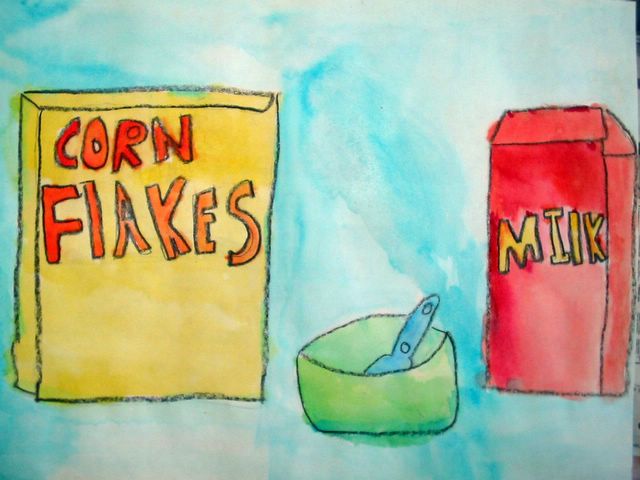
Students worked on creating precise geometric shapes such as rectangular prisms and sphere.
Posted by Picasa
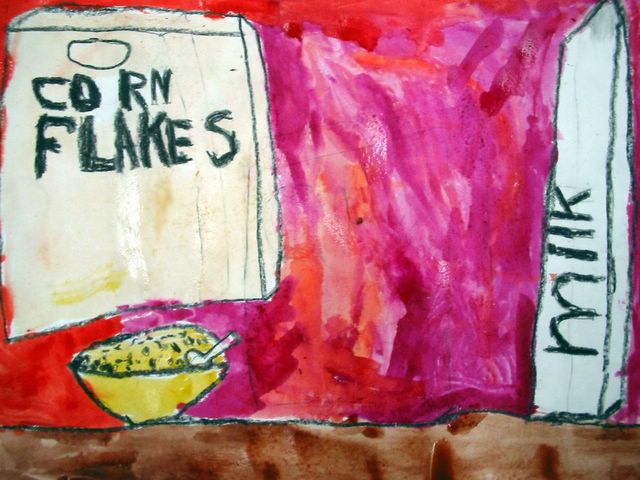
Monday, September 19, 2005
Great Day
Today was another great day. We had a fantastically focused morning as we read the story “Stevie” in the Open Court book. I was really impressed by how students applied what they had learned about story structure and problem/solution to making good predictions about what might happen in the story.
For those people, who gave me email addresses, I sent you logon information about the Gradebook. If you haven’t given me an email yet, or if you would like to change it, please send a note to jbasse1@lausd.k12.ca.us and I’ll take care of that right away.
Tonight’s math deals with the very tricky subject of estimation. You child may need some extra handholding. Be sure to NOT find the exact answers.
Homework: (1) Study spelling words for the week. (2) Types of Sentences, Reading and Writing Workbook, page 12 only. (3) Compound words, Reading and Writing Workbook, pages 17-18. (4) Estimation, Math, pages 38-39, all problems.
For those people, who gave me email addresses, I sent you logon information about the Gradebook. If you haven’t given me an email yet, or if you would like to change it, please send a note to jbasse1@lausd.k12.ca.us and I’ll take care of that right away.
Tonight’s math deals with the very tricky subject of estimation. You child may need some extra handholding. Be sure to NOT find the exact answers.
Homework: (1) Study spelling words for the week. (2) Types of Sentences, Reading and Writing Workbook, page 12 only. (3) Compound words, Reading and Writing Workbook, pages 17-18. (4) Estimation, Math, pages 38-39, all problems.
Friday, September 16, 2005
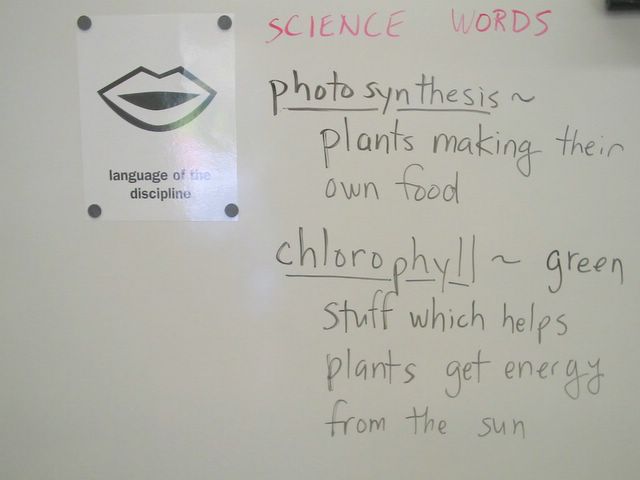
We're using Dr Kaplan's depth and complexity icon cards to help focus the enrichment of our learning.
Posted by Picasa
Restless Learning
Not every day is absolutely perfect.
We started today with a fire-drill and lunch procedures assembly on the yard, and it was just enough of a bit of weirdness in the day that the students never seemed to quite focus. Everything seemed to take longer than usual. I began to look at the clock and wonder when lunch would finally come….
Still, we have some solid learning to show for our day. About half of the students have completed their first complete Writer’s Workshop compositions. The others should be relatively close to a final draft soon. We took our spelling test, and the scores look excellent. We started to really analyze “Angel Child, Dragon Child” in Reading to understand how stories really worked. We learned important technical terms like “plot” and “character” and “setting” and “climax.” We talked about problem and conflict in a story, and how they are not always exactly the same thing. I challenged the students to find something in the text to back up their assertions about characters – that was really a new concept for them! So, I’m proud of the learning we’ve done.
I will be finishing setting up the Gradebook this weekend, and you should receive your email with logon and password by Monday morning. I think you will find this an invaluable tool.
I also changed the comment option on the blog so make it harder for strange comments to be automatically posted. You can still comment, and I’d love to see more comments, but you’ll need to type in the word you see on the screen, just like you have to do with Ticketmaster. It helps defeat the programs which automatically attach unwanted comments to blogs.
Finally, to all our families whose roots are in Korea, Happy Chu Sok.
Homework: As promised, just some math and the students had a chance to start it in class. (1) Predict & Test, page 45, all questions. (2) Add greater numbers, page 47-48, #2-44 only.
We started today with a fire-drill and lunch procedures assembly on the yard, and it was just enough of a bit of weirdness in the day that the students never seemed to quite focus. Everything seemed to take longer than usual. I began to look at the clock and wonder when lunch would finally come….
Still, we have some solid learning to show for our day. About half of the students have completed their first complete Writer’s Workshop compositions. The others should be relatively close to a final draft soon. We took our spelling test, and the scores look excellent. We started to really analyze “Angel Child, Dragon Child” in Reading to understand how stories really worked. We learned important technical terms like “plot” and “character” and “setting” and “climax.” We talked about problem and conflict in a story, and how they are not always exactly the same thing. I challenged the students to find something in the text to back up their assertions about characters – that was really a new concept for them! So, I’m proud of the learning we’ve done.
I will be finishing setting up the Gradebook this weekend, and you should receive your email with logon and password by Monday morning. I think you will find this an invaluable tool.
I also changed the comment option on the blog so make it harder for strange comments to be automatically posted. You can still comment, and I’d love to see more comments, but you’ll need to type in the word you see on the screen, just like you have to do with Ticketmaster. It helps defeat the programs which automatically attach unwanted comments to blogs.
Finally, to all our families whose roots are in Korea, Happy Chu Sok.
Homework: As promised, just some math and the students had a chance to start it in class. (1) Predict & Test, page 45, all questions. (2) Add greater numbers, page 47-48, #2-44 only.
Thursday, September 15, 2005
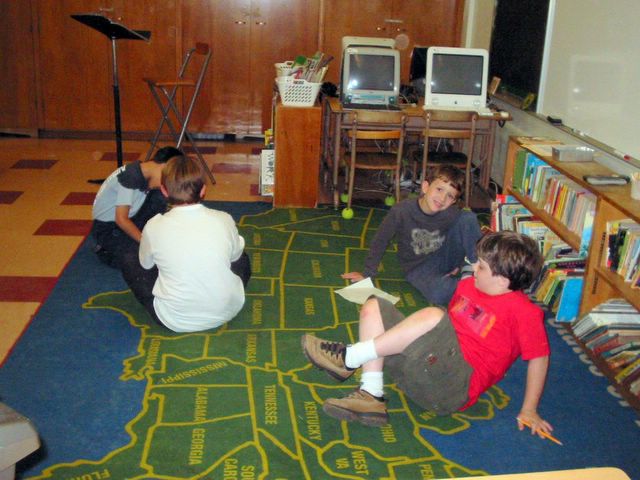

Patterns
Today we looked at patterns in different ways. In reading, we studied the patterns we saw in our Open Court blending words. We noticed the three ways of making the /k/ sound, and the different types of short vowel word patterns: CVC, CVCC, VC, and VCC. We also talked about the predictable patterns we find in plots. We discussed how most stories have a problem or a conflict which needs to be solved or resolved. We looked at how the author did this in the story, “Angel Child, Dragon Child.” After we created a flow map of the plot, we then went on to storyboard the story using the different key plot points we had identified. In math, besides sharpening our addition skills, we learned the pattern of numbers in base 8: 1, 2, 3, 4, 5, 6, 7, 10! The children have been counting the school days since the beginning of the year in Base 10, Base 8 and in Roman numerals.
Homework: (1) Study spelling for tomorrow’s test. (2) Science, page A23, questions 1-4 only. Please copy the question. (2) Math, page 43, all problems. Skip the part about estimation – we will come back to estimation a little later.
Homework: (1) Study spelling for tomorrow’s test. (2) Science, page A23, questions 1-4 only. Please copy the question. (2) Math, page 43, all problems. Skip the part about estimation – we will come back to estimation a little later.
Wednesday, September 14, 2005
Thanks for a Wonderful Event
A big thank you to all the parents who came last night to our Back-to-School event. I think, looking over the sign-in list, that at least 16 of our 21 families were represented. I had a really great time talking with everyone, and I am sure that the good communication we started last night will continue through the year.
If you did not have a chance to get the Internet Gradebook Program sheet to me last night, please get it in as soon as possible. I will be setting up accounts in the next couple days. Check that inbox!
Today was also our first library day, and the students did extremely well showing how well they remembered our library procedures and manners. I was very proud of them.
We will be having our first math test soon on place value. As I said last night, we may start grouping in math soon to make sure that everyone is appropriately challenged. For now, we will be skipping over chapter 2 for now to work on addition and subtraction. Remember, you can start working with your child on multiplication facts at anytime! You don't have to wait until it comes up in homework.
Homework: (1) Study spelling words. (2) Columnar Addition, page 37, all problems. (3) Add Three Digit Numbers, page 41, #1-10 only.
If you did not have a chance to get the Internet Gradebook Program sheet to me last night, please get it in as soon as possible. I will be setting up accounts in the next couple days. Check that inbox!
Today was also our first library day, and the students did extremely well showing how well they remembered our library procedures and manners. I was very proud of them.
We will be having our first math test soon on place value. As I said last night, we may start grouping in math soon to make sure that everyone is appropriately challenged. For now, we will be skipping over chapter 2 for now to work on addition and subtraction. Remember, you can start working with your child on multiplication facts at anytime! You don't have to wait until it comes up in homework.
Homework: (1) Study spelling words. (2) Columnar Addition, page 37, all problems. (3) Add Three Digit Numbers, page 41, #1-10 only.
Tuesday, September 13, 2005
Tonight, tonight
Our meeting tonight will begin at 5:30. You can bring your children. Armando, who works with Ms Hutchinson, will watch them on the yard. I’m looking forward to seeing everyone!
Since most parents will be coming to our meeting tonight at 5:30, I’ll just briefly note the homework.
Homework: (1) Study spelling words. (2) Do Chapter Review, page 14 and Cumulative Review, page 15 in the math book.
Since most parents will be coming to our meeting tonight at 5:30, I’ll just briefly note the homework.
Homework: (1) Study spelling words. (2) Do Chapter Review, page 14 and Cumulative Review, page 15 in the math book.
Monday, September 12, 2005
Monday Moaning? Not here!
It was a delight to see everybody back at school for our second week. Our class is starting to settle into their new routine.
We began our day with Reader's Workshop. Students are starting to have conferences with me after they read their books. We then continued on to our Open Court block. We completed our Concept/Question board just in time for a visit by Mrs Oh and the new "literacy coach," both of whom seemed reasonably impressed. We also discussed a little bit about point-of-view. This is a hard concept for students to really grasp. They superficially can scan for words like "I" or "me" or "our" to determine the narrative voice, but they start to get really confused when we add dialogue to the story. We'll be working on this all year. We concluded with some writing time before recess.
After recess, we continued our unit on plants by starting to study photosynthesis. We then took off to the Tech Center where the students began to learn touch typing. After lunch, we did some relay races as part of PE time. This was interrupted, though, by a power failure which caused the fire bell to rang. The students (and staff) were more than a little confused by all this, but room 19 students were calm and cooperative.
We're coming to the end of the first chapter in the math book. Again, though we've stressed the distinction between digits and numbers, the students will not have a really deep understanding of this for a while. We'll keep talking about place value until the very last day of school.
Homework: (1) Study the spelling list. (2) "Understand 10,000," Math book, page 11, all problems. (3) "Logical Reasoning," page 13, numbers 1-7 only.
We began our day with Reader's Workshop. Students are starting to have conferences with me after they read their books. We then continued on to our Open Court block. We completed our Concept/Question board just in time for a visit by Mrs Oh and the new "literacy coach," both of whom seemed reasonably impressed. We also discussed a little bit about point-of-view. This is a hard concept for students to really grasp. They superficially can scan for words like "I" or "me" or "our" to determine the narrative voice, but they start to get really confused when we add dialogue to the story. We'll be working on this all year. We concluded with some writing time before recess.
After recess, we continued our unit on plants by starting to study photosynthesis. We then took off to the Tech Center where the students began to learn touch typing. After lunch, we did some relay races as part of PE time. This was interrupted, though, by a power failure which caused the fire bell to rang. The students (and staff) were more than a little confused by all this, but room 19 students were calm and cooperative.
We're coming to the end of the first chapter in the math book. Again, though we've stressed the distinction between digits and numbers, the students will not have a really deep understanding of this for a while. We'll keep talking about place value until the very last day of school.
Homework: (1) Study the spelling list. (2) "Understand 10,000," Math book, page 11, all problems. (3) "Logical Reasoning," page 13, numbers 1-7 only.
Friday, September 09, 2005
First Friday
I'll write a little more about the day later, but for now here's the homework.
Homework: (1) Finish Science questions, page A 17. Do numbers 1-4 only. Copy question as well as answer. (2) Place value to 10,000, Math book, pp 8-9, numbers 8-54. We started this in class and did 1-7 together.
Homework: (1) Finish Science questions, page A 17. Do numbers 1-4 only. Copy question as well as answer. (2) Place value to 10,000, Math book, pp 8-9, numbers 8-54. We started this in class and did 1-7 together.
Thursday, September 08, 2005
Place Value
One of the hardest concepts for students is, unfortunately, the one that begins our study of third grade math. And that’s place value.
Now, for adults, place value has become second nature. But for children, they do not at all get the distinction between 4 as a digit and 4 as a number. They look the same, so aren’t they the same?
We will be spending all year working to really get the idea. One way we will be doing this will be by exploring a couple different number systems. One is the Roman numeral system. There’s nothing like having to figure out what MMDCCXXI is to appreciate the genius of our Hindu-Arabic numerals! The other is base 8, what we call Simpsons math since the characters on the Simpsons only have 4 fingers on a hand. Here children will learn to count 1, 2, 3, 4, 5, 6, 7, 10, 11, and so on. I find that alternative basic really make us understand place value.
So, we begin our math each day by counting which day of school it is in each of the three systems.
Homework: (1) Study spelling words for tomorrow’s quiz. (2) Math, pp 4-5, #1-30.
Now, for adults, place value has become second nature. But for children, they do not at all get the distinction between 4 as a digit and 4 as a number. They look the same, so aren’t they the same?
We will be spending all year working to really get the idea. One way we will be doing this will be by exploring a couple different number systems. One is the Roman numeral system. There’s nothing like having to figure out what MMDCCXXI is to appreciate the genius of our Hindu-Arabic numerals! The other is base 8, what we call Simpsons math since the characters on the Simpsons only have 4 fingers on a hand. Here children will learn to count 1, 2, 3, 4, 5, 6, 7, 10, 11, and so on. I find that alternative basic really make us understand place value.
So, we begin our math each day by counting which day of school it is in each of the three systems.
Homework: (1) Study spelling words for tomorrow’s quiz. (2) Math, pp 4-5, #1-30.
Wednesday, September 07, 2005
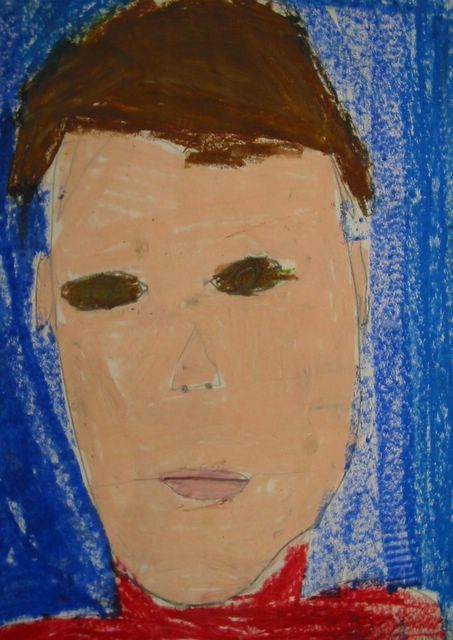
Day Two
The second day is sort of the first real day of school. We begin to settle down into a routine and the students begin to actually use their books and start learning. I like the second day better than the first usually!
Today we started with silent reading. Most classes call this DEAR. We call is Reader’s Workshop because we’ll do it slightly differently. For today, though, we just practiced picking books and reading. We also started our Writer’s Workshop. Today students brainstormed possible topics and started rough drafts. We also began our Open Court work today, focusing on what we know about our theme of Friendship. We start our phonics component with a view of consonants and short vowel words. Today we practice blending short a phonograms.
After lunch, we started our first Science unit on living things. The six weeks we spend on this prepares us nicely for the next Open Court theme, City Wildlife. We also started our music today. At first, since we are spending time working on steady beat and rhythmic speaking, students don’t quite get that it’s music, but nothing is more fundamental than rhythm.
After lunch, we did relays in PE and discussed odd and even in math. I explained how my two dogs could divide by two and knew the difference between odd and even. They liked the idea of canine math.
Homework: Students had about 15 minutes to start this in class so there should not be many questions.
Today we started with silent reading. Most classes call this DEAR. We call is Reader’s Workshop because we’ll do it slightly differently. For today, though, we just practiced picking books and reading. We also started our Writer’s Workshop. Today students brainstormed possible topics and started rough drafts. We also began our Open Court work today, focusing on what we know about our theme of Friendship. We start our phonics component with a view of consonants and short vowel words. Today we practice blending short a phonograms.
After lunch, we started our first Science unit on living things. The six weeks we spend on this prepares us nicely for the next Open Court theme, City Wildlife. We also started our music today. At first, since we are spending time working on steady beat and rhythmic speaking, students don’t quite get that it’s music, but nothing is more fundamental than rhythm.
After lunch, we did relays in PE and discussed odd and even in math. I explained how my two dogs could divide by two and knew the difference between odd and even. They liked the idea of canine math.
Homework: Students had about 15 minutes to start this in class so there should not be many questions.
- Finish the Science questions, page A 9. Most students did finish these in class.
- Write 4 statements and 4 questions. The content is unimportant here; I’m looking for correct use of capital and periods and to see if there are subjects and verbs in each sentence.
- Do the subtraction facts worksheet. This should be fast if the students really know the facts and aren’t counting on fingers.
- Do page 3 in the Math book. Write answers only on lined paper. This deals with odd and even.
- Continue studying spelling if needed for Friday’s test.
Tuesday, September 06, 2005

The first day of school
The first day of school is always so hard for everybody, no matter how often you’ve done it. Children are nervous of course, but so are parents and teachers. Somehow it seems so important that the first day be just right.
Well, our first day went quite well, I think. All 21 of us showed up, and almost everybody right on time. Students completed Interest Inventories which will help me to guide them toward books in Independent Reading which will be just right for them. They also did a pre-test of third grade skills from the Open Court series. I took a little longer than I thought it would, but I was impressed by their seriousness.
We took a tour of the campus so they would know where to play during recess. We also practiced our line order and walking in line.
Returning to our classroom, we partnered up and interviewed our partners. We took the information we gained from the interview and wrote rough drafts. I corrected those and the students did final drafts.
After recess, I did our first portrait of the year. We will study this skill more in depth later, but for today we did a rough sketch of the person we interviewed and used crayons or oil pastels to color it.
I stayed with the students during lunch today so that they could get a feel for the lunchtime routine. This year we have three lunches, and it seemed much calmer and quieter than last year with fewer children eating at the same time.
After lunch, I gave the students who still needed to work on final drafts a little more time while the students who were done got a head start on the math homework. We then discuss the basic rules which apply in any classroom, including, of course, ours. Their wording of the rules was slightly different from mine, but the basic values and ideas were the same.
Tomorrow, we’ll start learning our daily schedule and the “how to” of each activity on the schedule.
Homework: Homework starts our very easy at first. I like to give students a feeling of success and confidence. We can then decided how to make it more challenging for some students. For tonight,
Well, our first day went quite well, I think. All 21 of us showed up, and almost everybody right on time. Students completed Interest Inventories which will help me to guide them toward books in Independent Reading which will be just right for them. They also did a pre-test of third grade skills from the Open Court series. I took a little longer than I thought it would, but I was impressed by their seriousness.
We took a tour of the campus so they would know where to play during recess. We also practiced our line order and walking in line.
Returning to our classroom, we partnered up and interviewed our partners. We took the information we gained from the interview and wrote rough drafts. I corrected those and the students did final drafts.
After recess, I did our first portrait of the year. We will study this skill more in depth later, but for today we did a rough sketch of the person we interviewed and used crayons or oil pastels to color it.
I stayed with the students during lunch today so that they could get a feel for the lunchtime routine. This year we have three lunches, and it seemed much calmer and quieter than last year with fewer children eating at the same time.
After lunch, I gave the students who still needed to work on final drafts a little more time while the students who were done got a head start on the math homework. We then discuss the basic rules which apply in any classroom, including, of course, ours. Their wording of the rules was slightly different from mine, but the basic values and ideas were the same.
Tomorrow, we’ll start learning our daily schedule and the “how to” of each activity on the schedule.
Homework: Homework starts our very easy at first. I like to give students a feeling of success and confidence. We can then decided how to make it more challenging for some students. For tonight,
- Do the addition facts worksheet.
- Study the spelling words – no need to write anything.
- Bring in a photograph or a picture if you don’t have a photograph of you and a friend doing something together. This photo will be returned when the friendship unit is over. It is for our Concept/Question board.
Saturday, September 03, 2005
Welcome
I’d like to welcome all the new students and their parents to third grade and to room 19. I am excited and looking forward to a very productive year together. This blog will be an important part of how I work with families and let them know what is going on in our classroom. It will not only tell you what we have done each day, but will also explain what the homework is.
Our first day of school, as you all know, I’m sure, will be Tuesday, September 6th. Please arrive on time. Our school day begins currently at 8:05. Please understand that I do not have time on Tuesday morning to discuss your child’s needs and other things in detail. It’s not that I’m not interested, but there is just too much going on for me to really listen.
I have tentatively scheduled a parent meeting for our class only on Tuesday, September 13th, at 5:30 p.m.. Please let me know if it is impossible for you to come at that time. If we have quite a few people for whom this time does not work, we may need to reschedule the meeting.
The best way to contact me is by email. You can use either my school account jbasse1@lausd.k12.ca.us or my home account johndavidbassett@comcast.net. I check both of them frequently so I’m sure to get your message and be able to respond fairly quickly.
Our first day of school, as you all know, I’m sure, will be Tuesday, September 6th. Please arrive on time. Our school day begins currently at 8:05. Please understand that I do not have time on Tuesday morning to discuss your child’s needs and other things in detail. It’s not that I’m not interested, but there is just too much going on for me to really listen.
I have tentatively scheduled a parent meeting for our class only on Tuesday, September 13th, at 5:30 p.m.. Please let me know if it is impossible for you to come at that time. If we have quite a few people for whom this time does not work, we may need to reschedule the meeting.
The best way to contact me is by email. You can use either my school account jbasse1@lausd.k12.ca.us or my home account johndavidbassett@comcast.net. I check both of them frequently so I’m sure to get your message and be able to respond fairly quickly.
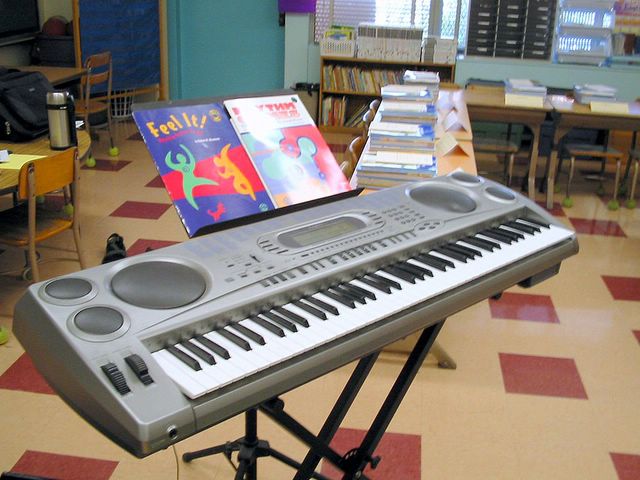
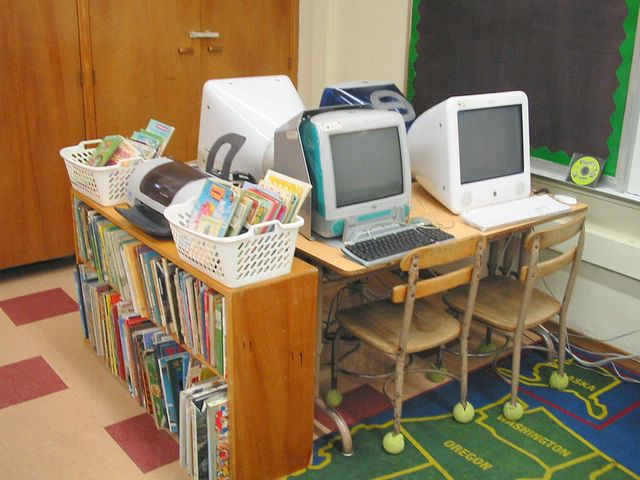

Universal concepts and big ideas help children to connect knowledge across disciplines and to connect what they learn in school with their own experiences.
Posted by Picasa
Thursday, June 09, 2005
Our three "trenches" -- one had artifacts of the Native period, another of the rancho period, and a third was from the more contemporary decades.
Posted by Hello

There's such a feeling of excitement when you uncover something in the dig! Here we found an old camera in the "contemporary" trench.
Posted by Hello


Tuesday, May 24, 2005
Last Short Tuesday
Today was our last shortened day of the year. I'm not sorry! I'd rather spend the time with my students than at a faculty meeting any day!
It was a productive day. We spent our morning doing Reader's Workshop and Writer's Workshop. The current page totals are on the gradebook for you to check. Two students currently have well over 1000 pages since March! Wow! I'm a little behind on giving credit for the writing, but that should be current by Monday. I really enjoy working one-on-one with the students on their writing, discussing strategies and helping correct mistakes. We then started on the next story in Open Court, "Just Plain Fancy" by Patricia Polacco. This is a fictional account of two Amish girls who accidentally raise a peacock and fear they will be shunned because the showy bird is too "fancy." We just go started today, doing blending and vocabulary and reading about half the story.
After recess, we again split into two groups that worked on Mrs Caruso's play. I worked with the musicians on Tallis' Canon. It's starting to come together. After lunch, Mrs Caruso had to leave early to deal with an automotive crisis, so Ms Jan and I worked with both classes on their math.
Homework: Just keep working on the math workbook.
It was a productive day. We spent our morning doing Reader's Workshop and Writer's Workshop. The current page totals are on the gradebook for you to check. Two students currently have well over 1000 pages since March! Wow! I'm a little behind on giving credit for the writing, but that should be current by Monday. I really enjoy working one-on-one with the students on their writing, discussing strategies and helping correct mistakes. We then started on the next story in Open Court, "Just Plain Fancy" by Patricia Polacco. This is a fictional account of two Amish girls who accidentally raise a peacock and fear they will be shunned because the showy bird is too "fancy." We just go started today, doing blending and vocabulary and reading about half the story.
After recess, we again split into two groups that worked on Mrs Caruso's play. I worked with the musicians on Tallis' Canon. It's starting to come together. After lunch, Mrs Caruso had to leave early to deal with an automotive crisis, so Ms Jan and I worked with both classes on their math.
Homework: Just keep working on the math workbook.
Monday, May 23, 2005
Country Fair Afterglow
Well, I had a chance to see a number of you at Country Fair on Saturday. Nida and Alejandro performed with Ms Kullman's group, and I thought they stole the show. I unfortunately miss Paolo's performance since some group times were rearranged. I'm sure he was great, too.
It was awfully hot, as I'm sure I don't need to tell you, and I spent too much time in the sun and felt it for the rest of the weekend. In fact, I still felt a little solar "hangover" today. At least my shoulders did! But I had a great time, and I was delighted to see our basket did quite well. Thank you to everybody who contributed!
Today, Mrs Caruso began rehearsing her play with the actors, and I started to work on the music. For the First Thanksgiving scene, we will be playing Thomas Tallis' famous "Canon" on recorder in four parts over a repeating "g" sounding on the metalophone to imitate a church bell. After each the canon, we will bridge over into having the whole "Pilgrim Chorus" (not Wagner's!) sing the tune to words which the students will help write.
Homework: Continue work on the math book. Students should be about 1/3 done with the text by now. Also, remember that Science Fair has been moved up from Friday to Thursday. Contributing a Science Fair project is not required, but will help students move from a "3" to a "4" in Science.
It was awfully hot, as I'm sure I don't need to tell you, and I spent too much time in the sun and felt it for the rest of the weekend. In fact, I still felt a little solar "hangover" today. At least my shoulders did! But I had a great time, and I was delighted to see our basket did quite well. Thank you to everybody who contributed!
Today, Mrs Caruso began rehearsing her play with the actors, and I started to work on the music. For the First Thanksgiving scene, we will be playing Thomas Tallis' famous "Canon" on recorder in four parts over a repeating "g" sounding on the metalophone to imitate a church bell. After each the canon, we will bridge over into having the whole "Pilgrim Chorus" (not Wagner's!) sing the tune to words which the students will help write.
Homework: Continue work on the math book. Students should be about 1/3 done with the text by now. Also, remember that Science Fair has been moved up from Friday to Thursday. Contributing a Science Fair project is not required, but will help students move from a "3" to a "4" in Science.
Thursday, May 19, 2005
The Play's the Thing
Today we started to return to what Warren Harding famously called "normalcy." Testing is over, and our field trip is done. We can now get back to that wonderfully productive routine.
Certainly that's how our morning went. We had Reader's Workshop, and then during Independent Work Time we reviewed our last story on dairy farming and began to look at the next story about the Amish. We worked on a lot of hard words today during blending. Four-syllable words are now the norm for blending, but everyone seems to understand the way to look at the words and separate them into syllables. We then discussed some vocabulary. We read and discussed the story.
After recess, we turned our attention to the play that Mrs Caruso helped to write. It is pretty long! In the story, two children pick up their mother's cell phone and are instantly transported back to the Plymouth of the first Thanksgiving. They meet up with two Wampanoag children. After some initial hesitation, they become friends. The two Native American children are concerned that their mother might die unless she receives some medication, so once they learn about the time travel phone, they want to come along to the future to get the medication. From Plymouth, the children journey through the Cumberland Gap where they meet Daniel Boone, and then attend the unveiling of the Freedman's Memorial in Washington D.C. where they meet Frederick Douglas. They go to San Francisco to see the Summer of Love, and then journey 500 years to the future where they discover the genial reason for their adventures. It's an interesting romp through American history.
I proposed to Mrs Caruso that I would watch members of both classes after lunch while she held auditions for the major roles. With Ms Jan, the RST aide, to help me, this went quite well. Mrs Caruso should be announcing the cast tomorrow or Monday. Once she is working with the actors, I will work with the musicians.
Homework: (1) Write a summary of what was seen and learned on the trip to Cabrillo. (2) Continue to work on the math workbook.
Certainly that's how our morning went. We had Reader's Workshop, and then during Independent Work Time we reviewed our last story on dairy farming and began to look at the next story about the Amish. We worked on a lot of hard words today during blending. Four-syllable words are now the norm for blending, but everyone seems to understand the way to look at the words and separate them into syllables. We then discussed some vocabulary. We read and discussed the story.
After recess, we turned our attention to the play that Mrs Caruso helped to write. It is pretty long! In the story, two children pick up their mother's cell phone and are instantly transported back to the Plymouth of the first Thanksgiving. They meet up with two Wampanoag children. After some initial hesitation, they become friends. The two Native American children are concerned that their mother might die unless she receives some medication, so once they learn about the time travel phone, they want to come along to the future to get the medication. From Plymouth, the children journey through the Cumberland Gap where they meet Daniel Boone, and then attend the unveiling of the Freedman's Memorial in Washington D.C. where they meet Frederick Douglas. They go to San Francisco to see the Summer of Love, and then journey 500 years to the future where they discover the genial reason for their adventures. It's an interesting romp through American history.
I proposed to Mrs Caruso that I would watch members of both classes after lunch while she held auditions for the major roles. With Ms Jan, the RST aide, to help me, this went quite well. Mrs Caruso should be announcing the cast tomorrow or Monday. Once she is working with the actors, I will work with the musicians.
Homework: (1) Write a summary of what was seen and learned on the trip to Cabrillo. (2) Continue to work on the math workbook.
Wednesday, May 18, 2005


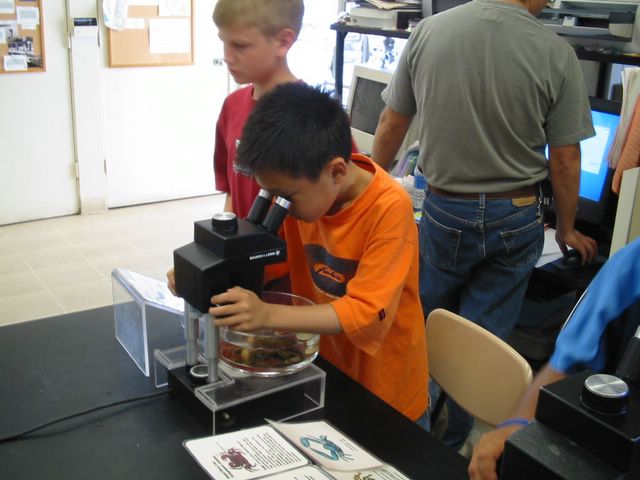
Cabrillo
A most pleasant trip to the Cabrillo Marine Museum today. We boarded the bus a little after nine o'clock, and we started the LONG drive down to San Pedro. Once we arrive, we were ushered into the auditorium where we watched a most informative slideshow about tidepools led by a smart, funny, and very cool guide. They then split us into two groups to take turns visiting the tidepool touch tanks and the lab. In both places, we got to really feel the creatures. Some of us thought that they were a little slimy, while others had a great time touching away. We had a short lunch (and we kept most of it away from the seagulls) and then we walked out to the tidepools themselves. We got a chance to see a lot of the things we'd seen in the slides. On the way back to the bus, a pod of dolphins popped up out of the waves as if to say, "Come again!"
Many of you had a chance to come to the parent meeting yesterday, and some of you VERY generously contributed. Mrs. Caruso and I will be splitting responsibility for the play that she and Talia's mom wrote together. She will be in charge of directing the play and designing sets and costumes. I will be responsible for working with a group to develop and perform appropriate music for the play. I'll help her out as I can with the sets, but I'm not nearly the artist she is! We don't have much time, but we'll give it our all.
Homework: Keep working on the math textbook. Other than that, nada.
Many of you had a chance to come to the parent meeting yesterday, and some of you VERY generously contributed. Mrs. Caruso and I will be splitting responsibility for the play that she and Talia's mom wrote together. She will be in charge of directing the play and designing sets and costumes. I will be responsible for working with a group to develop and perform appropriate music for the play. I'll help her out as I can with the sets, but I'm not nearly the artist she is! We don't have much time, but we'll give it our all.
Homework: Keep working on the math textbook. Other than that, nada.
Friday, May 13, 2005

Another of our Ox-Cart Man pictures. Note the wonderful use of color and the sense of perspective.
Posted by Hello
New Math
Today was the Language Arts section of the CAT 6. This is currently the section of the testing used to evaluate students for placement in gifted programs, so I have always urged the students to do it with particular care. I think they did reasonably well, though I try not to look over their shoulders. The urge to say, "Think about that one again!" is so strong when you see a silly mistake. Unfortunately, the state does not let us give that kind of assistance on tests.
Since we are basically finished with the math book -- it's such a rush to "cover" everything by the first of May -- I gave the students some math books I've had in my cupboard for a few years. These will help review some of the number sense and problem solving skills and will also give them a taste of what to expect next year in fourth grade. They will be working on these books in school and at home for the next month. Students seem pretty excited by their new texts.
I just learned today that we will be putting on a play next month. The inspiration for this came from Mrs Caruso, and we will be involved with room 17 in doing this. There will be a special meeting about the play and about upcoming events next Tuesday at 7:45 am. If you can possibly attend, please come. If you cannot make it, please email Mrs Caruso to get details. Write her at kcaruso@lausd.k12.ca.us.
Homework: Finish Heartland questions if these were not completed in class. Continue work innew math books.
Since we are basically finished with the math book -- it's such a rush to "cover" everything by the first of May -- I gave the students some math books I've had in my cupboard for a few years. These will help review some of the number sense and problem solving skills and will also give them a taste of what to expect next year in fourth grade. They will be working on these books in school and at home for the next month. Students seem pretty excited by their new texts.
I just learned today that we will be putting on a play next month. The inspiration for this came from Mrs Caruso, and we will be involved with room 17 in doing this. There will be a special meeting about the play and about upcoming events next Tuesday at 7:45 am. If you can possibly attend, please come. If you cannot make it, please email Mrs Caruso to get details. Write her at kcaruso@lausd.k12.ca.us.
Homework: Finish Heartland questions if these were not completed in class. Continue work innew math books.
Thursday, May 12, 2005

The ox-cart man starting to walk home from Portsmouth market with the kettle he bought.
Posted by Hello
Hanging In
Today was the last day of the California Standards Test. Tomorrow we start the CAT 6 portion. By Monday, deity of your choice willing, will be done. It's hard for them to keep the energy up. But they're really trying. I can tell that.
We checked yesterday's work first thing, and we read and discussed the "Heartland" poem. We talked about what the "heartland" is and why people call it that. We also scanned several lines of the poem so that students could learn what couplets are and about iambic. (The poem is written in irregular stanzas of iambic quadrameter). After recess, we also had Reader's Workshop and Writer's Workshop.
In the afternoon we finished up Minnie and Moo, a rather odd book about a ragtag group of animals who try to save the farm. We reviewed "Ox-Cart Man" and students were assigned lines of the poem to illustrate as a first step towards the culminating project. One of the works is shown above.
Homework: No homework is the only really good part of testing week, isn't it?
We checked yesterday's work first thing, and we read and discussed the "Heartland" poem. We talked about what the "heartland" is and why people call it that. We also scanned several lines of the poem so that students could learn what couplets are and about iambic. (The poem is written in irregular stanzas of iambic quadrameter). After recess, we also had Reader's Workshop and Writer's Workshop.
In the afternoon we finished up Minnie and Moo, a rather odd book about a ragtag group of animals who try to save the farm. We reviewed "Ox-Cart Man" and students were assigned lines of the poem to illustrate as a first step towards the culminating project. One of the works is shown above.
Homework: No homework is the only really good part of testing week, isn't it?
Tuesday, May 10, 2005


Finishing Lap Two
Sunday was the Kentucky Derby. I did not watch it, but watching the reports about the race on the news made me wonder what exactly the horses thing about it. Do they get a thrill from seeing how fast they can run around the track? Do they want to win? Or do they just wonder why the heck they have to run around in circles?
State testing is sort of like this, I think. Some students seem to sense that there is some kind of competition going on here, and you can tell they take it seriously. There's an energy there. Other children just have a resignation which lets you know that they think that this is sort of a pointless as running around a short track a whole bunch of times.
Either way, we finished "lap two." This concludes both sections of the English Language Arts section of the California Standards Test. It's probably the most tiring for the children. Two days of math testing follow. These tests seem shorter, though they're actually the trickiest.
Homework: All have earned a day off.
State testing is sort of like this, I think. Some students seem to sense that there is some kind of competition going on here, and you can tell they take it seriously. There's an energy there. Other children just have a resignation which lets you know that they think that this is sort of a pointless as running around a short track a whole bunch of times.
Either way, we finished "lap two." This concludes both sections of the English Language Arts section of the California Standards Test. It's probably the most tiring for the children. Two days of math testing follow. These tests seem shorter, though they're actually the trickiest.
Homework: All have earned a day off.
Monday, May 09, 2005
Testing begins
Students did the first section of the CST (California Standards Test) today. I think it is one of the hardest sections, so it's nice that we're done with that. Tomorrow, we'll continue with the language arts sections, and then start the math on Wednesday.
Today was -- groan! -- rainy day schedule. And I wasn't in the mood for it. We had a really whiny lunch recess, so I dug out every worksheet I could find and assigned them for an afternoon independent work session. Suddenly, all was calm and pleasant. If they worked hard during this time, they should NOT have much if any homework. Everything listed below was assigned to them at 1:00 pm, and they had 90 minutes to work on it.
Homework: (1) Science, questions WB 97. Copy questions. (2) "Ox-Cart Man" open-book quiz. (3) Alphabetical order worksheet. (4) Equivalent fractions WS. (5) Multiplication WS.
Today was -- groan! -- rainy day schedule. And I wasn't in the mood for it. We had a really whiny lunch recess, so I dug out every worksheet I could find and assigned them for an afternoon independent work session. Suddenly, all was calm and pleasant. If they worked hard during this time, they should NOT have much if any homework. Everything listed below was assigned to them at 1:00 pm, and they had 90 minutes to work on it.
Homework: (1) Science, questions WB 97. Copy questions. (2) "Ox-Cart Man" open-book quiz. (3) Alphabetical order worksheet. (4) Equivalent fractions WS. (5) Multiplication WS.
Thursday, May 05, 2005
Country Life
Today we began our final Open Court unit, "Country Life". I particularly like this unit because it really allows the students to think about urban and rural life, past and present. We began today by starting to create our Concept/Question board. The children understood that there were lots of farms and therefore animals in the country, but were a little unclear about anything else. Our unit will help, I think, to broaden this understanding.
We started reading and discussing the first selection, "Ox-Cart Man", a poem by Donald Hall. (I have a particular fondness for this poem, and I developed a lesson plan for the Education Devision of the LA County Music Center based on it. We will be following this lesson plan in its broadest outlines, though I'm making some changes.) The poem helps students see the rhythm of life for a family on a farm in New Hampshire in the 1850's. I admit another bias here: the poet was one of my professors at the University of Michigan back in the 1970's.
The selections which follow help students see country life today. "I am the Heartland" is a paen to the agricultural sector. It provides students with the opportunity to see that urban and rural life are intertwined, even though it has a political undertone which sometimes makes me wonder if it was not commissioned by Archer-Daniels-Midland. There is an informative selection on dairy farming called "Cows in the Parlor".
There are a couple of selections about the Amish. These probably cause the students to assume that there are a lot more Amish farming families than there really are, but they find the life of the Amish interesting. Neither really explains the religious motivations of the Amish, so I try to provide a succinct and objective introduction to Anabaptist movement to place these in context. They usually look a little blankly at me when I do this, but I feel like I need to explain that the Amish are not doing this just to look cute.
There is a long and hard to read selection to the problem of urban sprawl called "Whatever Happened to the Baxter Place?". This is an important one for me because my sister is a professor of urban planning at Michigan State University and stopping urban sprawl is one of her professional and personal passions. I've got to figure out a way this year to make this selection for lively to the students.
The unit ends with a big question and a little answer. The question is, "Which is better, rural or urban life?" Unfortunately, the only thing that McGraw Hill seemed able to find to address this question was the tedious old Aesop fable about the "Country Mouse and the City Mouse". I suppose that student's cultural literacy would not be complete without knowing this, but it seems like a trite answer. We'll do better in class.
Homework: The students have had a heavy load lately, and they're getting a night off. Unless they have some classwork to finish, they should have a free evening. Enjoy!
We started reading and discussing the first selection, "Ox-Cart Man", a poem by Donald Hall. (I have a particular fondness for this poem, and I developed a lesson plan for the Education Devision of the LA County Music Center based on it. We will be following this lesson plan in its broadest outlines, though I'm making some changes.) The poem helps students see the rhythm of life for a family on a farm in New Hampshire in the 1850's. I admit another bias here: the poet was one of my professors at the University of Michigan back in the 1970's.
The selections which follow help students see country life today. "I am the Heartland" is a paen to the agricultural sector. It provides students with the opportunity to see that urban and rural life are intertwined, even though it has a political undertone which sometimes makes me wonder if it was not commissioned by Archer-Daniels-Midland. There is an informative selection on dairy farming called "Cows in the Parlor".
There are a couple of selections about the Amish. These probably cause the students to assume that there are a lot more Amish farming families than there really are, but they find the life of the Amish interesting. Neither really explains the religious motivations of the Amish, so I try to provide a succinct and objective introduction to Anabaptist movement to place these in context. They usually look a little blankly at me when I do this, but I feel like I need to explain that the Amish are not doing this just to look cute.
There is a long and hard to read selection to the problem of urban sprawl called "Whatever Happened to the Baxter Place?". This is an important one for me because my sister is a professor of urban planning at Michigan State University and stopping urban sprawl is one of her professional and personal passions. I've got to figure out a way this year to make this selection for lively to the students.
The unit ends with a big question and a little answer. The question is, "Which is better, rural or urban life?" Unfortunately, the only thing that McGraw Hill seemed able to find to address this question was the tedious old Aesop fable about the "Country Mouse and the City Mouse". I suppose that student's cultural literacy would not be complete without knowing this, but it seems like a trite answer. We'll do better in class.
Homework: The students have had a heavy load lately, and they're getting a night off. Unless they have some classwork to finish, they should have a free evening. Enjoy!
Wednesday, May 04, 2005
Putting it all Together
Today we spent most of the morning reviewing what we learned from our study of money. Students were called on one by one. Each could either recall something from memory about what they learned about money or go to the Concept/Question board and take off and read one of the entries. You can guess what choice appealed to most of them. As each idea was recalled, I put it on cluster or webs on the board. The students carefully copied the webs down. After they finished the webs, we brainstormed a sentence which could be used as a sentence which seemed to introduce or sum up the cluster. They will use these tonight to help guide writing a multiple paragraph essay. The sentences we brainstormed can be used as topic sentences for the various paragraphs. This is really a fourth grade kind of assignment, but I think they're ready to give it a try!
In math, students are learning to compare decimals. This is always a little tricky. Student instinctively think that 0.11 must be bigger than 0.9 because 11 is bigger than 9! It sort of makes sense, no matter how wrong it is! For this reason, we really must insist that they say "zero point one one" instead of "zero point eleven" which most of them will want to do. Of course, translating the decimals into equivalent fractions is what REALLY shows understanding.
Homework: (1) Math, Decimals p. 159, #1-14. (2) Write a three to five paragraph essay about money. Summarize what we discussed throughout the unit. Use the three clusters/webs developed in class this morning to guide you, including the sample topic sentences.
In math, students are learning to compare decimals. This is always a little tricky. Student instinctively think that 0.11 must be bigger than 0.9 because 11 is bigger than 9! It sort of makes sense, no matter how wrong it is! For this reason, we really must insist that they say "zero point one one" instead of "zero point eleven" which most of them will want to do. Of course, translating the decimals into equivalent fractions is what REALLY shows understanding.
Homework: (1) Math, Decimals p. 159, #1-14. (2) Write a three to five paragraph essay about money. Summarize what we discussed throughout the unit. Use the three clusters/webs developed in class this morning to guide you, including the sample topic sentences.
Tuesday, May 03, 2005
Finishing up
Today we did the final parts of our LAST Open Court test of the year. We did the Vocabulary test and the Writing Assessment. The first was pretty hard; the second was somewhat ludicrous. It asked the students to suppose that one of their friends had written a letter to them asking them how to earn and save money. Yeah, right. A nine year old Warren Buffett, I suppose.
Still, the students seemed to do quite well on both parts. Grades will be posted shortly on the Internet: www.teacherease.com.
Homework: (1) Math, page 525, #1-14, 16-20. (2) Math, pages 527, all problems. (3) Science, page C37, #20-29.
Still, the students seemed to do quite well on both parts. Grades will be posted shortly on the Internet: www.teacherease.com.
Homework: (1) Math, page 525, #1-14, 16-20. (2) Math, pages 527, all problems. (3) Science, page C37, #20-29.
Subscribe to:
Posts (Atom)